Kurdish control over Syria's north raises controversy, deep concernsReports indicating that Syrian Kurds have been gaining control over major Kurdish towns and cities near the Turkish border have sparked a debate on whether a new Kurdish self-governing region is emerging next to Iraqi Kurdistan and fueled concerns that the area may turn into a new base for the Kurdistan Workers' Party (PKK).
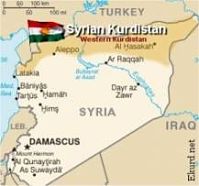
Syrian Kurdish groups have reportedly gained control of several towns, including Kobane and Efrin in Aleppo and Amude in the city of al-Hasakah, over the past few days, while negotiations with Syrian forces for the peaceful surrender of Qamishli, the biggest Kurdish city in Syria, are under way. Turkish media have published conflicting reports over what has been happening in the Kurdish areas of Syria since last week, when the Syrian forces were apparently moved from the north to Damascus and other regions to strike back at the opposition fighters after a major attack in the capital last Wednesday that killed the Syrian defense minister and two other senior officials. Some reports say the PKK has sent its militants to the Kurdish region in Syria while others maintained it was the peshmerga forces of the Iraqi Kurdish administration that have been dispatched to the area to “protect the Syrian Kurdish population from the PKK-affiliated Democratic Union Party [PYD].”
Kurdish authorities denied the latter claim. “A number of newspapers and websites have published reported [sic] that Kurdish Peshmerga forces have entered Kurdistan of Syria, but we firmly reject that news as baseless and far from the truth,” the website of the Kurdistan Region Presidency quoted a presidential spokesperson as saying.
Syrian Kurds, for their part, confirmed that Kurdish forces did enter recently from Iraqi Kurdistan but said they were Syrian Kurdish soldiers who had defected from the Syrian military, not peshmerga forces as reported by some media outlets and the Syrian Arab opposition.
“The Kurdish forces that recently entered from Iraqi Kurdistan into the Kurdish areas of Syria are Syrian Kurdish soldiers who defected from the Syrian army and resorted to Iraqi Kurdistan, where they received military training and got organized, and now they are back to participate in the liberation of their own cities and villages from the armed forces of the Assad regime,” a Syrian Kurdish activist, identified as Yilmaz Saeed, was quoted as saying on Kurdish website Rudaw. On Monday, the Turkish Vatan daily reported that some 2,000 PKK militants had been sent to the region. It was not possible to independently verify the report.
The Syrian Kurds were first divided over how to respond to a widespread revolt against President Bashar al-Assad’s rule, with the PYD supporting the Assad regime, saying its opponents are backed by foreign countries such as Turkey while an umbrella organization of more than 10 Kurdish parties -- named the Kurdish National Council (KNC) of Syria -- was more inclined to join the anti-Assad movement.
The differences between the Kurds as a whole and the Syrian National Council, the main Syrian opposition group, also appear to be deep. The KNC, which attended an SNC meeting in Cairo early this month, walked out of the meeting in protest of the Syrian opposition’s insistence to refer to Syria as an Arab nation and accept the Kurds’ existence as a separate nation.
The differences between the two Kurdish groups, the KNC and the PYD, were reconciled during a meeting summoned by Iraqi Kurdish leader Massoud Barzani last month in Arbil, northern Iraq. The two groups reportedly agreed to jointly run the Kurdish areas of Syria, creating three committees on foreign relations, peace and order and supervision of public services. The deal also appears to have been based on a mutual agreement that the Kurds will act on their own, aligning themselves neither with the Sunni Arab opposition nor the Assad regime.
Thus, when the Free Syrian Army, an armed opposition group of mostly Syrian army defectors, offered help, the armed wing of the Kurdish alliance, called Protection Forces, made it clear that they are neither needed nor welcome in the Kurdish region.
In a sign of PKK dominance, reports from the region also said the PKK flag, along with the Kurdish flag, was hoisted in state buildings in Kurdish towns “liberated” from the Syrian army.
Tensions with FSA
Turkey has long had troubled relations with the Iraqi Kurds because they offered a safe haven for the PKK in northern Iraq. But ties have improved drastically over the recent years after the Barzani administration committed to supporting Turkey’s counterterrorism efforts. But prospects that the Barzani-brokered deal among the Syrian Kurds may pave the way for a new Kurdish autonomous region next to the Iraqi Kurdistan where the PKK calls the shots have already raised worries in Turkey.
Another source of concern is whether the de facto Kurdish autonomy in northern Syria would speed up the feared disintegration of Syria by sparking tensions between the Arab opposition and the Kurds, in addition to the already raging battle between the pro-Assad Alawites and the Sunni Arab opposition.
Speaking to Today’s Zaman, a senior FSA commander played down prospects for Kurdish separatism, saying the PKK and the PYD do not have popular support. Malik al-Kurdi, the FSA’s deputy leader, speaking in an interview in Hatay province on the Syrian border, claimed the PYD was unpopular because of its pro-Assad actions. Al-Kurdi also said the Syrian Kurds would not be willing to create their own state within Syria and vowed to stop if there is ever an attempt to this effect. “The FSA will never let it happen,” he said.
http://www.todayszaman.com/news-287438- ... cerns.html









 , well I hope .