Navigator
Facebook
Search
Ads & Recent Photos
Recent Images
Random images
Welcome To Roj Bash Kurdistan 

14 April Anfal Remembrance Day 182,000 murdered

A place to talk about domestic politics in Middle East (Iran, Iraq , Turkey, Syria) Also includes topics about Assyrian, Armenian, Chaldean .

14 April Anfal Remembrance Day 182,000 murdered

PostAuthor: Anthea » Thu Apr 14, 2016 2:49 am

We at Roj Bash Kurdistan Respectfully offer our heart felt condolences to all the relatives and friends of those who lost their live during Saddam's Anfal campaign

NEVER FORGOTTEN - NEVER FORGIVEN

R I P

818

Kurdish Genocide Saddam Hussein was determined to wipe out the Kurds in Iraq.

In 1980s, he launched a genocidal campaign that he code named Anfal.

During this carefully planned, eight stage operation, 182,000 men, women and children were killed.

The Anfal is part of a wider genocide that began decades earlier in which hundreds of thousands of innocent people perished, families were torn apart and 4,500 villages were destroyed.

The genocide consisted of the use of chemical weapons countless numbers of times, including in Halabja; the disappearance of 8,000 Barzani boys and men in 1983; and the killing of Faylee Kurds in the 1970s and 1980s.

The Anfal was the peak of the genocide, a crime committed while most of the world was silent.

In Kurdistan, April 14 is the day marked every year for remembrance of the notorious Anfal Campaign.

Although Anfal began before April 14, 1988, the Ba'athist regime launched the largest Anfal operations in the Garmian areas in south and southeast of Slemani on that day.
Last edited by Anthea on Thu Apr 14, 2016 9:08 am, edited 1 time in total.
My Name Is KURDISTAN And I Will Be FREE
User avatar
Anthea
Shaswar
Shaswar
Donator
Donator
 
Posts: 31601
Images: 1151
Joined: Thu Oct 18, 2012 2:13 pm
Location: Sitting in front of computer
Highscores: 3
Arcade winning challenges: 6
Has thanked: 6019 times
Been thanked: 750 times
Nationality: Kurd by heart

14 April Anfal Remembrance Day 182,000 murdered

Sponsor

Sponsor
 

Re: 14 April Anfal Remembrance Day 182,000 murdered

PostAuthor: Anthea » Thu Apr 14, 2016 8:55 am

Remember the more than 8,000 members of the Barzani clan who disappeared and were presumed killed in 1983 by the regime of Saddam Hussein

The bodies were eventually dug out of a mass grave in Bsaya in southern Iraq, not far from the border with Saudi Arabia.

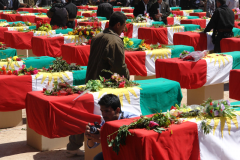
Kurdish peshmerga fighters dressed in traditional baggy brown pants and with their heads wrapped in red-and-white keffiyeh scarves escorted the coffins off a plane and lined them up on the tarmac.

Widows carrying tissues and photos of their dead husbands and sons sobbed, even men in traditional Kurdish dress were unable to hide their emotion at the sight of so many coffins, each covered in a red-white-and-green Kurdish flag emblazoned with a shining sun.

After the ceremony, the coffins were placed in cars and driven 200 kilometers (125 miles) north to Barzan, a mountain village near the Turkish border where they were to be buried in a cemetery reserved especially for them.

Iraqi forces under Saddam committed the 1983 massacre of the Kurdish tribe of Mullah Mustafa Barzani, the founding father of Iraqi Kurdistan and the father of the current Kurdish president, who died in March 1979.

Saddam's regime rounded up around 8,000 men from the tribe in northern Iraq, took them into the desert and executed them.

WORLD LEADERS DID NOTHING
My Name Is KURDISTAN And I Will Be FREE
User avatar
Anthea
Shaswar
Shaswar
Donator
Donator
 
Posts: 31601
Images: 1151
Joined: Thu Oct 18, 2012 2:13 pm
Location: Sitting in front of computer
Highscores: 3
Arcade winning challenges: 6
Has thanked: 6019 times
Been thanked: 750 times
Nationality: Kurd by heart

Re: 14 April Anfal Remembrance Day 182,000 murdered

PostAuthor: Anthea » Thu Apr 14, 2016 9:07 am

Al-Anfal and the Genocide of Iraqi Kurds, 1988

The al-Anfal campaign in 1988 was a genocidal military operation led by Saddam Hussein's Ba’athist regime against the ethnic Kurds of northern Iraq. Set in the context of the Iran-Iraq War (1980-1988), the predominately Kurdish area of northern Iraq was seen as a strategic vulnerability to the Ba’athist regime, and a brutal counterinsurgency was waged to vanquish the perceived threat. At least 182,000 Kurdish lives were taken and thousands of Kurdish villages were destroyed through the use of chemical weapons, aerial attacks, and a host of other modes of destruction. Since 2003, the Iraqi Special Tribunal convicted many of the operation’s leaders with crimes against humanity, genocide, and premeditated murder.

The Kurdish people are the fourth largest ethnic and linguistic group in the Middle East, following in size the Arabs, Turks, and Persians. Sharing such ancient origins, the Kurds have their own tradition of cultural independence. After World War I, both President Woodrow Wilson's principle of national self-determination and the 1920 Treaty of Sèvres promised to carve out a sovereign state of Kurdistan. Such commitments were soon reneged upon with the 1923 Treaty of Lausanne, stranding Kurds as national minorities in other countries. Today, some 40 million Kurds live in their indigenous hearth region that overlaps eastern Turkey, northern Syria, northern Iraq, and northwestern Iran. Pockets of the Kurdish diaspora extend even further, ranging from former Soviet satellites to Western Europe and North America.

In northern Iraq, a Kurdish irredentist movement sputtered through the British Mandate of the 1920s and into the origins of the Iraqi state the following decade. 1961 began a more enduring campaign of rebellion, and soon after the Ba’athist military coup in 1968 the Iraqi Kurds were nominally granted some limited autonomy. This was only a ruse, however, to provide cover for “Arabization,” a project of internal colonialism that sought to integrate and exploit this resource-rich region. Coveting the region’s valuable oil fields, fertile land, mineral wealth, and upstream access to the Tigris River, the Ba’athist regime, under the dictatorship of Saddam Hussein after 1979, forcibly evicted tens of thousands of Kurdish families. Many fled as refugees to Iran.

Over the course of the Iran-Iraq war, which lasted from 1980 to 1988, the Kurds were increasingly seen as an irredentist “fifth column." Ali Hassan al-Majid, a cousin of Saddam and the Defense Minister, was delegated the task of vanquishing this perceived strategic liability, whereby he earned the notorious moniker, "Chemical Ali." Al-Anfal was the brutal counterinsurgency campaign he waged against the Kurds of northern Iraq. Consisting of eight separate operations and lasting from February until September 1988, the most infamous incident was on March 16, 1988, with the ruthless chemical weapons attack on the Kurdish town of Halabja, near the Iranian border. THOUSANDS of civilians were killed, KNOWN THOUSANDS more injured and dying later from health complications. Foreign journalists, such as Turkish photographer Ramazan Öztürk, arrived soon after the massacre, graphically documenting Halabja for posterity.

Chemical attacks were only one mode of destruction, as al-Anfal intended to definitively “cleanse” the region through mass deportation. Iraqi security forces rounded up civilians into concentration camps, the most notorious of which was Topzawa near the city of Kirkuk. Adult males and teenage boys were selected from the camps for mass execution, while many children, women, and the elderly perished from disease and starvation. The Kurdish presence in northern Iraq was devastated by al-Anfal. Verifiable statistics are difficult to obtain, but MANY THOUSANDS of Kurds lost their lives, most of who were non-combatants, and about 90% of Kurdish villages in the targeted area were attacked.

Primary documentation of the genocide by the Iraqi Secret Police was captured by Kurdish forces following yet another uprising at the end of the 1991 Gulf War. This material was used in Human Rights Watch’s investigation of al-Anfal and is now available at the University of Colorado at Boulder's Archive. After the 2003 American invasion and subsequently tumultuous occupation, the Supreme Iraqi Criminal Tribunal (formerly known as the Iraqi Special Tribunal) was established to adjudicate the transgressions of the Ba’athist regime. It has focused on genocide, crimes against humanity, war crimes, and other egregious acts. Saddam Hussein was tried and convicted for crimes against humanity, although the Tribunal did not charge him with connection al-Anfal. "Chemical Ali" was prosecuted for his direct role, however, was found guilty of genocide by the Tribunal and executed in January 2010.
My Name Is KURDISTAN And I Will Be FREE
User avatar
Anthea
Shaswar
Shaswar
Donator
Donator
 
Posts: 31601
Images: 1151
Joined: Thu Oct 18, 2012 2:13 pm
Location: Sitting in front of computer
Highscores: 3
Arcade winning challenges: 6
Has thanked: 6019 times
Been thanked: 750 times
Nationality: Kurd by heart

Re: 14 April Anfal Remembrance Day 182,000 murdered

PostAuthor: Anthea » Thu Apr 14, 2016 3:19 pm

KRG says efforts underway to improve livelihood of Anfal victims' families

SULAIMANI — The Kurdistan Regional Government (KRG) released a written statement on Thursday (April 14) to commemorate Anfal Remembrance Day, saying efforts were underway to assist the families of Anfal victims.

“The KRG is prepared to find and return the remains of Anfal victims to their homes and is committed to improving the livelihood of the victims’ families,” the KRG statement said.
820

The government of the Kurdistan Region is urging the international community to officially recognize the Anfal campaign as a genocide committed against Iraq’s Kurdish population

The KRG blames the Iraqi central government for a failure to compensate the families of the victims and says areas where the Anfal campaign was carried out have not received aid from the federal government.

The KRG statement encouraged unity among the Kurdish parties to overcome the current situation facing the Kurdistan Region.

THE KURDISTAN REGION MARKS ANFAL REMEMBRANCE DAY

The Kurdistan Region commemorates Anfal Remembrance Day on Thursday (April 14), which marks the end of the genocidal campaign against the Kurds in the north of Iraq by Saddam Hussein’s Ba’ath Regime.

The Anfal campaign, launched and led by Ba’ath Party Secretary-General Ali Hassan al-Majid, is widely understood to have begun in 1986 and lasted through 1988. Ground offensives, aerial bombardments, systematic destruction of villages and mass deportations were used as part of the campaign that killed and disappeared an estimated 182,000 Kurds.

NRT correspondent Wrya Hama Karim said a French diplomatic delegation headed by French ambassador to Iraq Mark Bertini would attend a remembrance ceremony in the eastern town of Halabja.

A chemical weapons attack on Halabja in 1988, as part of the Anfal campaign, killed up to 5,000 people and wounded thousands more. Countless thousands died painfully later as a result of effects of the chemical weapons used.

The children went on to the streets to smell the apples

A number of international governments have recognized the Anfal campaign as genocide against Iraq’s Kurdish population, including Sweden, Norway, the United Kingdom and South Korea.

Norway officially recognized Anfal as genocide in November 2012 and was followed by Sweden’s parliament, which adopted a similar resolution in December 2012. The U.K. and South Korean governments recognized the Anfal campaign as genocide in March and June of 2013 respectively.

The U.S. Consulate General in Erbil issued a message to its official Facebook page Thursday, expressing sadness for the victims of the campaign, which also included Ezidis, Assyrians and other Iraqi minorities.

Kurdistan Regional Government (KRG) Council of Ministers called on Kurdish people to stand for one over a minute as a respect for the Anfal campaign.

“The United States joins others across Iraq and around the world in remembering the victims of the Anfal,” the statement said.

“We reaffirm our commitment to stand with all Iraqis, including those in the Kurdistan Region, as they work to defeat Da’esh and ensure a secure, democratic and economically prosperous future for Iraq,” it continued, referring to the Islamic State (IS), which has carried out a campaign targeting minorities in northern Iraq.

The Kurdistan Regional Government (KRG) also marked the day with employees in Erbil and Sulaimani observing a minute of silence early in the day.

Meanwhile, families of Anfal victims held a demonstration and blocked the Sulaimani-Kirkuk highway. The families said they were protesting over salary delays.

The mayor of Chamchamal, located along the highway between Sulaimani and Kirkuk, said his town would not hold remembrance ceremonies, upon a request by victims’ families, who say their lives have not improved since the end of the Anfal campaign.

Residents of Garmiyan and Tuz Khurmatu districts also said they would not mark the day, citing similar reasons.

A significant number of villages in those areas were destroyed during the Anfal campaign, and many victims were from villages and towns in the southern part of the Kurdistan Region.

Kurdish blocs in the Iraqi Parliament called on Speaker Salim al-Jabouri to issue and official apology for the campaign on Wednesday (April 13), which led to a fight that erupted during an emergency session to discuss new cabinet posts.

Iraqi Parliament member Rebwar Taha spoke with NRT and said his faction and Anfal victims had been insulted by other MPs after the request for an apology.

At least three members of the Iraqi Parliament were wounded as the session erupted into chaos.

http://www.nrttv.com/EN/Details.aspx?Jimare=6340
My Name Is KURDISTAN And I Will Be FREE
User avatar
Anthea
Shaswar
Shaswar
Donator
Donator
 
Posts: 31601
Images: 1151
Joined: Thu Oct 18, 2012 2:13 pm
Location: Sitting in front of computer
Highscores: 3
Arcade winning challenges: 6
Has thanked: 6019 times
Been thanked: 750 times
Nationality: Kurd by heart


Return to Middle East

Who is online

Registered users: Bing [Bot], Google [Bot]

x

#{title}

#{text}