


Is your TV eavesdropping on PRIVATE conversations?
Samsung reveals its smart sets can capture every word
By Victoria Woollaston
Samsung's privacy policy warns users about having private conversations
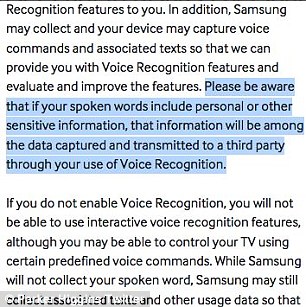
It said: 'If your words include sensitive information, that information will be among the data captured and transmitted to a third party'
Samsung smart TVs have voice recognition to capture spoken commands
It uses these commands to carry out tasks and improve the voice features
Last year, Which? experts monitored of data from a range of smart TVs
They discovered all brands track people’s viewing habits to some extent
And users give permission to do this in the TV's terms and conditions
If viewers reject conditions they can't access some features on their TV sets - and Samsung and Toshiba owners can't use them at all
Smart TVs and high-end games consoles that 'listen' to voice commands are becoming increasingly popular.
But Samsung is today under fire for what it does with this audio information after it is collected.
In its privacy policy, the South Korean firm has revealed that if their conversations contain 'personal or other sensitive information', this will be captured and transmitted to an unidentified third party.
And this has concerned privacy campaigners.
Electronic Frontier Foundation activist Parker Higgins tweeted that the Samsung terminology is similar to an excerpt from George Orwell's dystopian novel 1984.
The full Samsung policy, first highlighted by The Daily Beast, says: 'If you enable Voice Recognition, you can interact with your smart TV using your voice.
'To provide you the Voice Recognition feature, some voice commands may be transmitted (along with information about your device, including device identifiers) to a third-party service that converts speech to text or to the extent necessary to provide the Voice Recognition features to you.
'In addition, Samsung may collect and capture voice commands and associated texts so that we can provide you with Voice Recognition features and evaluate and improve the features.'
It is not known what this external service is, or what happens to the captured data once it is no longer needed, and MailOnline has contacted Samsung for further clarification.
A Samsung spokesman told MailOnline: 'Samsung takes consumer privacy very seriously.
'In all of our Smart TVs, any data gathering or their use is carried out with utmost transparency and we provide meaningful options for consumers to freely choose or to opt out of a service.'
Voice recognition lets the user control the TV using voice commands.
It has to be activated in the first instance, and can be deactivated at any time.
Once enabled, Samsung told MailOnline that the voice data only consists of TV commands, or search sentences.
But this is not what the privacy policy suggests and MailOnline has requested further clarification.
The spokesman continued that Samsung doesn't sell voice data to third parties and that the voice data is sent to a service, which searches for the requested content then sends it back to the TV.
He continued that anyone who is concerned about data collection should contact Samsung directly.
The news follows years of concerns about how much data smart TV sets capture and send.
In 2012, Malta-based security firm ReVuln posted a video showing how its researchers had learned to crack a Samsung television to access its settings - including any personal information stored on it.
'We can install malicious software to gain complete root access to the TV,' they claimed in the video.
With such malware installed, hackers could use the TV's built-in microphones and camera to hear and see everything in front of it.
Last summer, a Which? investigation then discovered just how much data the manufacturers can gather.
Experts monitored streams of data coming from 2013 and 2014 models of smart TVs made by LG, Samsung, Sony, Panasonic and Toshiba.
During the investigation, the experts changed channel, searched the web and played videos from a USB stick to see what information was collected.
'RED BUTTON' FEATURE COULD BE USED TO HIJACK WEB ACCOUNTS
A team of scientists at Columbia University claimed in June that hybrid smart TVs are vulnerable to a simple hack.
Coined the ‘red-button attack’ - named after the red button used on modern remotes to access additional content - the flaw can be exploited with a $250 (£150) transmitter.
In just minutes, someone using a smart TV could find their various internet accounts sending spam, printing coupons and writing fake reviews without their knowledge.
Hackers could, in theory, also use these accounts to harvest personal information.
The attack works by exploiting a vulnerability in Hybrid Broadcast-Broadband Television (HbbTV).
This ‘allows broadcast streams to include embedded HTML content which is rendered by the television,’ the researchers said.
The hacker then takes over the channel a viewer is watching for a short amount of time.
This would be done by using a simple amplifier to hijack networks across an area of 0.5 square miles (1.4 square km).
In doing so, the hacker gets access to any websites the viewer was logged into on their smart TV.
Full Article & Video:
http://www.dailymail.co.uk/sciencetech/ ... -word.html