Intel's 730 480GB SSD Skulltrail scorcher
 Posted: Thu Mar 06, 2014 10:43 pm
While Crucial and Samsung have been making waves in the consumer SSD market with their affordable – well, kind of affordable – 1TB drives, there has been a noticeable silence from one of the giants in the consumer space – Intel.
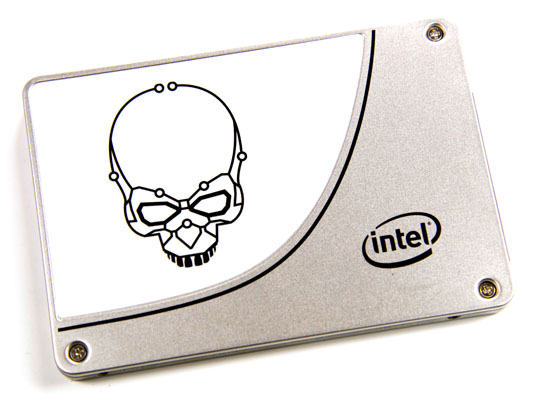
Yet with the launch of its latest series of drives – the 730 family built on a 7mm format – evidently the beast has awakened. At launch, Intel offers just two capacities – 240GB and 480GB – both are backed by a five-year warranty. Intel sent in a pair of 480GB drives for this review.
The new drives go straight into the flagship position of Intel’s line-up and are aimed at not so much at the average user, if there is such a thing, but rather the enthusiast. Intel has its eye on gamers, digital content creators and workstation users. To emphasise the point, the drives carry the Skulltrail logo found on Intel’s high end motherboards and Intel uses the snappy slogan “Data Centre DNA – Enthusiast Tuned” for the 730 range. It claims a class-leading write endurance of 70GB a day.
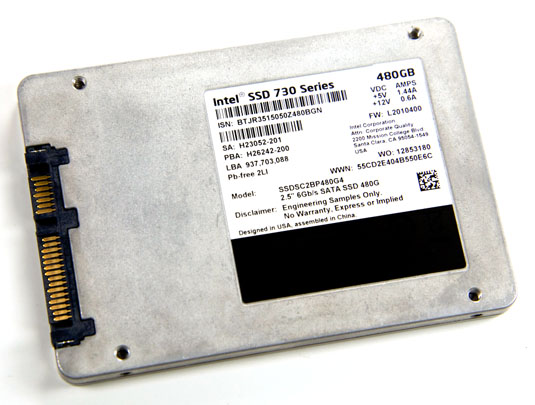
The new 730 SSDs rely on Intel’s third generation controller and the company’s 20nm MLC NAND. The hardware for both of these components has been cherry-picked from Intel’s production lines – one of the major benefits of being the manufacturer of this technology. It doesn’t stop there either, as the firmware for the controller is also in-house.
Exit Sandforce, enter Intel Enterprise
As it is targeted at consumers, the 730 series ends up being the first of its ilk to use Intel’s third generation controller, previously seen in action on the Enterprise DC S3700 and S3500 drives. This move sees the company switch back to its own silicon from the 6Gb/s LSI SandForce SF-2281 controllers it used in the 330, 335, 510 and 512 series of consumer drives. Indeed, it’s the first Intel-based drive for this market segment since the SSD 320 was launched some three years ago.
Built from the ground up, the new controller (coded PC29AS21CA0) is Intel’s first home grown 6Gb/s, 8-channel controller and supports AES-256 encryption. It may be the same controller that's in the DC S3700 and S3500 drives but for the 730, Intel has overclocked it. Yes, that’s right, it has been factory overclocked. The speed has risen from 400MHz to 600MHz and the company must have faith in the durability of this overclocked silicon given that five-year warranty.
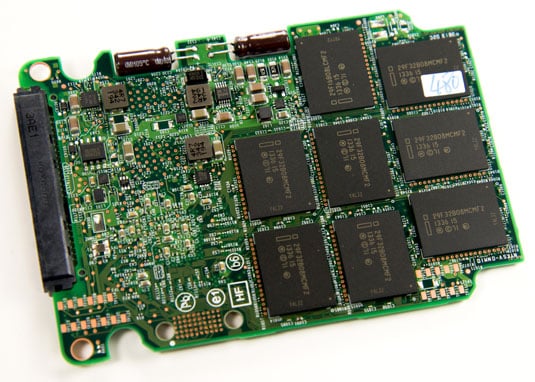
To get a look at the innards of the 730, you simply undo four tiny screws, there’s no oddly shaped fasteners, torx heads or the need to use a credit card to prise the cover apart. The layout of the PCB is very tidy and vaguely familiar. Hold on a minute, make that very familiar. Well, it is if you’ve ever opened up a DC S3500 Enterprise drive. When Intel says the design for the SSD 730 series was heavily influenced by the DC S3500, it’s not kidding. The similarity even extends to both drives having the same coding on the PCB.
With the exception of the two 512MB DDR3-1600 Micron DRAM chips that form the 1GB of cache, all the other chips on the board are Intel. It may look as if there are 16 identical 20nm NAND chips making up the 730’s capacity but a closer inspection shows that in actual fact there is a mix of NAND involved.
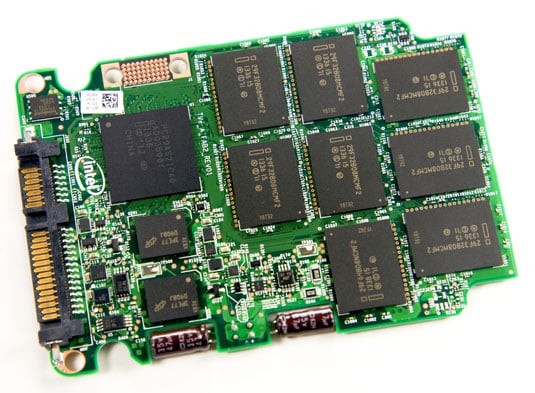
There are 14 29F32B08MCMF2 (32GB) packages, a single 29F64B08NCMF2 (64GB) package and a single chip of 29F16B08LCMF2 (16GB) NAND for a total of 528GB, the extra capacity being used for bad block replacement, wear levelling and suchlike.
As with the controller, the NAND bus is also overclocked, getting a mild boost of 17MHz, tweaking the original 83MHz up to 100MHz; increasing the bandwidth to a maximum of 200MHz instead of 166MHz for each channel. In keeping with both the DC S3700 and S3500 drives, the 730 comes with power loss protection in the form of two C-rated 3.5V capacitors on the PCB edge.
Bigger is better
Intel quotes sustained reads up to 550MB/s and 470MB/s for the 480GB model while the 240GB has the same 550MB/s read performance but a lowly 270MB/s write performance. When it comes to Random 4K Reads, the 480GB is quoted at 89,000 IOPS and 74,000 IOPS for writes.
The 240GB drive has lower performance all-round when dealing with small files; 86,000 and 56,000 IOPS for reads and writes respectively.
Enough of what Intel claims the drives can do, let’s throw some benchmarks at them to see what they can actually do.
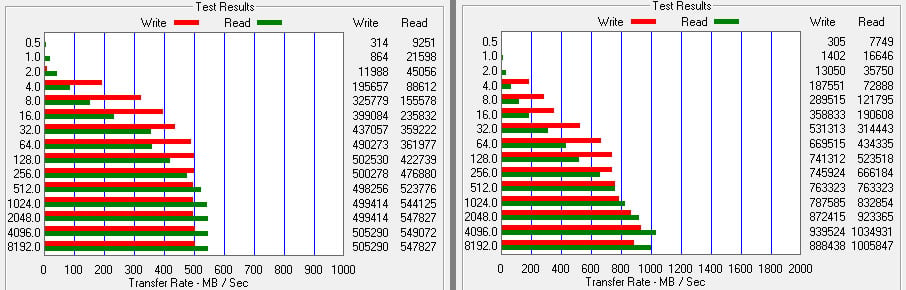
Starting off with the ATTO benchmark, the drive gave a sequential read score of 547MB/s which is pretty much what Intel claimed the drive could do. At 505MB/s, the sequential write test score of is a fair bit better than the official figure.
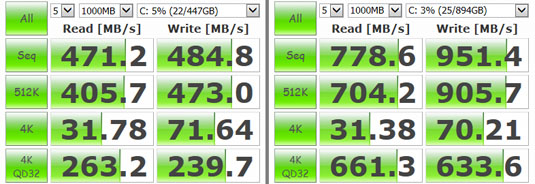
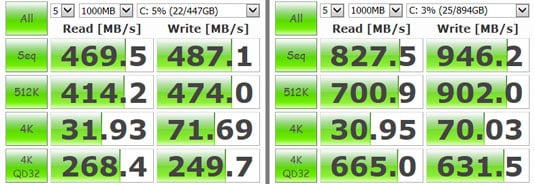
In CrystalDiskMark, the Sequential Read/Write scores were 471MB/s and 484MB/s, respectively. The benchmarks for compressed data produced a sequential read score of 469.5MB/s and 487.1MB/s for writes. Evidently, the controller isn’t too bothered whether the data is compressed or not.
I also did some real life testing, copying a 50GB folder of small files took a tadge under 10 minutes, a 17GB Blu-Ray image completed in two minutes 29 seconds and a 4GB image took 32 seconds. As Intel is aiming at content creation users, among others, I took the 4GB image and timed how long it took to open in Photoshop (2m 52s), re-image from 300dpi to 600pdi (17m 12s) and then save the resulting 16GB image it back to disk (14m 34s).
Two's company
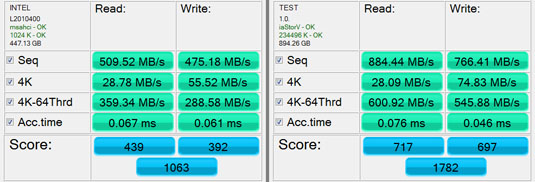
As Intel provided two 480GB drives, it seemed only polite that I should do some RAID testing with them. I built them into a RAID 0 array and then loaded Windows 7 Ultimate on it. Loading the OS took just six minutes as opposed to the 11 minutes on a solitary drive. Remember those ATTO scores for a single drive? When it comes to the RAID performance of the two drives together, things get pretty impressive. The Read score shoots up to 1GB/s while write climbed to 888MB/s. In CrystalDiskMark the read score went up to 778MB/s while the writes went to 951.4MB/s.
With the real life file transfers, the RAID array still took over nine minutes to copy the 50GB folder of files, which highlights how the 730 SSDs don’t really like handling small bitty files much. When it comes to copying the larger files, the array took some 10 seconds off the time to copy the 4GB image file and a huge 48 seconds off the BluRay file copy time.
It was a similar story with the image manipulation. The image took 46 seconds less to open, took four minutes less to render and it was nearly five minutes quicker saving the file.
The Reg Verdict
It has been quite some time but at last we have a home-grown Intel 6Gb/s SSD for the consumer space, albeit for the higher end of this market segment. While Intel was beavering away to deliver the 730 range, the SSD space has become much more competitive even at the high end.
Indeed, the price of the 480GB 730 looks a tad steep when you consider a Samsung 512GB Pro can be had for around a tenner or so less – not to mention a 960MB Crucial M500 for maybe another 15 quid or so more. Still, the 730 series does have that enterprise grade endurance claim and, of course, you can expect a certain level of reliability that accompanies the Intel logo. ®
Yet with the launch of its latest series of drives – the 730 family built on a 7mm format – evidently the beast has awakened. At launch, Intel offers just two capacities – 240GB and 480GB – both are backed by a five-year warranty. Intel sent in a pair of 480GB drives for this review.
The new drives go straight into the flagship position of Intel’s line-up and are aimed at not so much at the average user, if there is such a thing, but rather the enthusiast. Intel has its eye on gamers, digital content creators and workstation users. To emphasise the point, the drives carry the Skulltrail logo found on Intel’s high end motherboards and Intel uses the snappy slogan “Data Centre DNA – Enthusiast Tuned” for the 730 range. It claims a class-leading write endurance of 70GB a day.
The new 730 SSDs rely on Intel’s third generation controller and the company’s 20nm MLC NAND. The hardware for both of these components has been cherry-picked from Intel’s production lines – one of the major benefits of being the manufacturer of this technology. It doesn’t stop there either, as the firmware for the controller is also in-house.
Exit Sandforce, enter Intel Enterprise
As it is targeted at consumers, the 730 series ends up being the first of its ilk to use Intel’s third generation controller, previously seen in action on the Enterprise DC S3700 and S3500 drives. This move sees the company switch back to its own silicon from the 6Gb/s LSI SandForce SF-2281 controllers it used in the 330, 335, 510 and 512 series of consumer drives. Indeed, it’s the first Intel-based drive for this market segment since the SSD 320 was launched some three years ago.
Built from the ground up, the new controller (coded PC29AS21CA0) is Intel’s first home grown 6Gb/s, 8-channel controller and supports AES-256 encryption. It may be the same controller that's in the DC S3700 and S3500 drives but for the 730, Intel has overclocked it. Yes, that’s right, it has been factory overclocked. The speed has risen from 400MHz to 600MHz and the company must have faith in the durability of this overclocked silicon given that five-year warranty.
To get a look at the innards of the 730, you simply undo four tiny screws, there’s no oddly shaped fasteners, torx heads or the need to use a credit card to prise the cover apart. The layout of the PCB is very tidy and vaguely familiar. Hold on a minute, make that very familiar. Well, it is if you’ve ever opened up a DC S3500 Enterprise drive. When Intel says the design for the SSD 730 series was heavily influenced by the DC S3500, it’s not kidding. The similarity even extends to both drives having the same coding on the PCB.
With the exception of the two 512MB DDR3-1600 Micron DRAM chips that form the 1GB of cache, all the other chips on the board are Intel. It may look as if there are 16 identical 20nm NAND chips making up the 730’s capacity but a closer inspection shows that in actual fact there is a mix of NAND involved.
There are 14 29F32B08MCMF2 (32GB) packages, a single 29F64B08NCMF2 (64GB) package and a single chip of 29F16B08LCMF2 (16GB) NAND for a total of 528GB, the extra capacity being used for bad block replacement, wear levelling and suchlike.
As with the controller, the NAND bus is also overclocked, getting a mild boost of 17MHz, tweaking the original 83MHz up to 100MHz; increasing the bandwidth to a maximum of 200MHz instead of 166MHz for each channel. In keeping with both the DC S3700 and S3500 drives, the 730 comes with power loss protection in the form of two C-rated 3.5V capacitors on the PCB edge.
Bigger is better
Intel quotes sustained reads up to 550MB/s and 470MB/s for the 480GB model while the 240GB has the same 550MB/s read performance but a lowly 270MB/s write performance. When it comes to Random 4K Reads, the 480GB is quoted at 89,000 IOPS and 74,000 IOPS for writes.
The 240GB drive has lower performance all-round when dealing with small files; 86,000 and 56,000 IOPS for reads and writes respectively.
Enough of what Intel claims the drives can do, let’s throw some benchmarks at them to see what they can actually do.
Starting off with the ATTO benchmark, the drive gave a sequential read score of 547MB/s which is pretty much what Intel claimed the drive could do. At 505MB/s, the sequential write test score of is a fair bit better than the official figure.
In CrystalDiskMark, the Sequential Read/Write scores were 471MB/s and 484MB/s, respectively. The benchmarks for compressed data produced a sequential read score of 469.5MB/s and 487.1MB/s for writes. Evidently, the controller isn’t too bothered whether the data is compressed or not.
I also did some real life testing, copying a 50GB folder of small files took a tadge under 10 minutes, a 17GB Blu-Ray image completed in two minutes 29 seconds and a 4GB image took 32 seconds. As Intel is aiming at content creation users, among others, I took the 4GB image and timed how long it took to open in Photoshop (2m 52s), re-image from 300dpi to 600pdi (17m 12s) and then save the resulting 16GB image it back to disk (14m 34s).
Two's company
As Intel provided two 480GB drives, it seemed only polite that I should do some RAID testing with them. I built them into a RAID 0 array and then loaded Windows 7 Ultimate on it. Loading the OS took just six minutes as opposed to the 11 minutes on a solitary drive. Remember those ATTO scores for a single drive? When it comes to the RAID performance of the two drives together, things get pretty impressive. The Read score shoots up to 1GB/s while write climbed to 888MB/s. In CrystalDiskMark the read score went up to 778MB/s while the writes went to 951.4MB/s.
With the real life file transfers, the RAID array still took over nine minutes to copy the 50GB folder of files, which highlights how the 730 SSDs don’t really like handling small bitty files much. When it comes to copying the larger files, the array took some 10 seconds off the time to copy the 4GB image file and a huge 48 seconds off the BluRay file copy time.
It was a similar story with the image manipulation. The image took 46 seconds less to open, took four minutes less to render and it was nearly five minutes quicker saving the file.
The Reg Verdict
It has been quite some time but at last we have a home-grown Intel 6Gb/s SSD for the consumer space, albeit for the higher end of this market segment. While Intel was beavering away to deliver the 730 range, the SSD space has become much more competitive even at the high end.
Indeed, the price of the 480GB 730 looks a tad steep when you consider a Samsung 512GB Pro can be had for around a tenner or so less – not to mention a 960MB Crucial M500 for maybe another 15 quid or so more. Still, the 730 series does have that enterprise grade endurance claim and, of course, you can expect a certain level of reliability that accompanies the Intel logo. ®


