

The Kurdish community in Germany that I grew up in had more or less differing views among its members, but it largely comprised of patriots from Bakur whose hearts beat on the left. Initially, I was not fully conscious that not all of Kurdistan shared these ideas and later found it curious to find myself self-conscious - yes I admit: almost suspicious- when talking to Kurds from different regions. Is he or she one of our Kurds?
Seeing a woman from Rojhelat participate in the 2012 Hunger Strike in Strasbourg or witnessing families from Bashur joining demonstrations that were set up by our komels was often a source of inspiration for my friends and me. We would look up to them in admiration, as if it was somehow a very humbling experience to see them joining “our struggle”. But isn’t that the problem? That we conceive of Kurds from other regions as some sort of foreigners? Strong solidarities among different Kurdish communities are prevalent, but they often fail to relate to other shades of the Kurdish reality. We cooperate well locally, but lack a central solidarity, a focused loyalty. We evolved into multiple “We”s.
Recently getting more involved in social networking, I felt this strange feeling of cultural sensitivity creep up inside me, a carefulness in my expression with which I should normally be approaching other cultures, not my own. Isn’t it odd that we feel the need to be careful with what we want to express, knowing how much of a controversy the explicitness of our thoughts may enrage among our very own people? Though I love being controversial, it is important to keep in mind that unity may be impossible, if we arbitrarily throw ideologies at each other which may alienate some parts of the population. We need some sensitive time to heal and reconnect first, because the walls that we built to protect the borders that we drew within our own nation are often thicker than our international loyalties, the conscious ties we seek with third parties.
It is true that the variety of our people reflects the different struggles we faced, depending on the regions we found ourselves in. The amount of recognition and discrimination against Kurds differs by each area and therefore it is natural that we have developed different identities, even though we are all Kurds. It is an inevitable consequence of what has been done to our nation for imperialist interest. Our nation has multiple personalities, if you will.

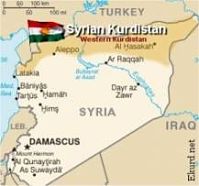
With regards to the current events in different parts of Kurdistan, I find it empowering to see a unified mentality and conscious solidarity crystallize out of events such as the Rojava Revolts, the bloody massacre in Roboski, the happenings of Şemzînan (Şemdinli), the attacks on BDP members in Amed, and the like. We may have tattooed campaigners that read Chomsky and Foucault on a regular basis on one and devout traditionalists on the other end of the continuum, but the one thing we have in common is our quest for identity. We are all pulling on the same string, when we chant “Bijî Kurdistan”. What we all share is the demand for freedom, for the recognition of our existence.
One time, my friend from Bashur and I wanted to dance govend together. We hooked our fingers and just as we were about to take off dancing, she stepped to the left and I stepped to the right – we didn’t know that the other was used to dancing in the opposite direction! Perhaps this is anecdotal of what is happening in Kurdistan? We have a common purpose, a common source, but sometimes go different ways…
The difficulty at this crucial stage for Kurdistan will be to find umbrella compromises that are sustainable for the future of this diverse nation. Yes, disunity and inadequacy are part of our fate as a nation that has been forcefully torn apart, but our diversity can also provide a wide range of insights. Now the art is to unify under the arguably most central common purpose of the people of Kurdistan, which is the desire for self-determination. It is important to take advantage of the diversity that a diasporic nation in a globalizing world can bring to the table. Modern fascism and imperialism may have disintegrated Kurdistan, but current developments appear as chances to heal national wounds and redefine ourselves by our own means as the people, instead of betraying each other. Despite the infinite ways in which we may disagree with our fellow Kurds, at this point in time, we need to hold onto the Kurdish spirit that is blowing across Mesopotamia at the moment - and unite!

http://dilar91.blogspot.co.uk/2012/08/b ... e-you.html