

Fierce ISIS resistance as Iraqi troops move on Mosul
Fourth day of battle to retake ISIL stronghold sees entrance of Iraqi special forces and an advance from the northeast.
Iraqi forces launched a third front in the offensive to take back Mosul but ISIL fighters put up stiff resistance, unleashing a wave of vehicle-borne suicide bombers, while leaving a deadly trail of hidden explosive devices.
Iraq's government said on Thursday its soldiers advanced from the south and east, while Kurdish Peshmerga fighters moved in from the north and east on the country's second-largest city, now under control of Islamic State of Iraq and the Levant, also known as ISIS.
Attack helicopters strafed ISIL positions as Iraq's special forces entered the town of Bartella, 15km east of Mosul's outskirts.
"After we break them in Bartella, everywhere else they will crumble," said Major-General Fadhil Barwari.
He said ISIL had few defences in the town, which was almost completely empty of civilians. "They just left some snipers and suicide car bombs."
ISIL fighters drove at least nine suicide car and truck bombs against the advancing troops, eight of which were destroyed before reaching their targets, while the ninth struck an armoured Humvee, Lieutenant-Colonel Muntadhar al-Shimmari told The Associated Press news agency.
The deadly defence offered a glimpse at what Iraqi forces can expect as they approach ISIL's biggest urban bastion.
Al Jazeera's Imran Khan, reporting from Erbil, said as of 2100 GMT on Thursday Bartella remained in the hands of ISIL and the fighting continued.
He reported the area of Bashiqa, northeast of Mosul, also remained besieged and Iraqi forces were fighting to take villages surrounding it.
"This is a very tough fight," Khan said. "They need to push through in order to open up a road that takes them 10km into Mosul via the highway. The battle is continuing and they are getting very close towards Mosul."
The US military announced the first American death since the operation began. The US soldier died on Thursday from wounds sustained in a roadside bomb explosion in northern Iraq, though the army didn't specify where.
In the areas surrounding Mosul, Iraqi troops can benefit from the use of air power and artillery, whereas the fight will be different once they enter the city, where most of the civilian population is concentrated, Khan reported.
"The closer you get to Mosul is where the civilians really are, and that's going to be a real challenge for both the Kurdish and the Iraqi security forces."
Battle for Mosul: The ISIL tunnels
The offensive is the largest operation launched by Iraqi forces since the 2003 US-led invasion.
Tens of thousands of troops are involved, while there are thought to be nearly 6,000 ISIL fighters in and around Mosul. It is expected to take weeks, if not months, before Mosul falls.
Amer al-Jabbar, a 30-year-old soldier with the Iraqi special forces, said he was happy to be taking part in the attack and hoped to avenge two brothers killed while fighting.
"I had one brother who became a martyr in 2007 and another who became a martyr in 2014," AP quoted him as saying. "I want to avenge them - and I'm ready to die."
ISIL captured Mosul during a lightning-quick advance across northern Iraq in 2014, and its leader Abu Bakr al-Baghdadi announced the formation of a self-styled caliphate from the pulpit of a Mosul mosque.
Mosul is the largest city controlled by the armed group and its last major urban centre in Iraq.
It is believed 1.5 million people have remained in the city, and the United Nations warned as many as one million people could flee in the coming days, creating a serious humanitarian crisis.
http://www.aljazeera.com/news/2016/10/f ... 26305.html

Facebook

Search

Welcome To Roj Bash Kurdistan

Mosul Massacre killed THOUSANDS of INNOCENT people
Re: Updates on Ongoing Mosul Massacre
 Author: Anthea » Thu Oct 20, 2016 11:09 pm
My Name Is KURDISTAN And I Will Be FREE
-

Anthea - Shaswar

- Donator

- Posts: 31601
- Images: 1151
- Joined: Thu Oct 18, 2012 2:13 pm
- Location: Sitting in front of computer
- Highscores: 3
- Arcade winning challenges: 6
- Has thanked: 6019 times
- Been thanked: 743 times
- Nationality: Kurd by heart
Re: Updates on Ongoing Mosul Massacre
Author: Anthea » Fri Oct 21, 2016 12:58 am
Karayılan: We will have an active position in the Mosul operation
PKK Executive Council Member Murat Karayılan said Turkey didn’t want PKK to take part in the Mosul operation, but they won’t stand on the sidelines and watch.
Karayılan said that the Kurds have a fragmented approach towards the Mosul operation, and that this was a great risk. Murat Karayılan said they were in contact with “respective forces” and that there was basis for their participation in the operation.
Murat Karayılan said the operation in Mosul was launched with mistakes in the military sense and it didn’t aim to end ISIS, just to make them flee.
ANF spoke with PKK Executive Council Member Murat Karayılan in Medya Defense Zones and he answered our questions on the Mosul operation and the situation in the region.
"KURDS SHOULD HAVE ACTED IN UNITY IN MOSUL"
The Mosul operation has officially been launched. What are your thoughts on the operation and the Kurds’ stance on it?
There is an apparent “war” on ISIS in our region. But in reality, the conflicts and clashes of the regional powers continue. The Mosul operation can be viewed in this sense as well. Mosul has an important place in history as well as the current day. And us Kurds should have been in unity in such a vital period of time. Both against the situation in the region and the Mosul operation, Kurds could have been acting in unity.
For the Mosul operation, Kurds could have met with the Iraqi administration, other regional forces and the US and displayed a united stance. Now, there is discussion on who will be in control after Mosul’s liberation. The question of “How and by whom will Mosul be controlled” is on the agenda, as Mosul is a city of peoples, not just one people. In the past, when people spoke of Mosul they spoke of Kurds. The Kurdish issue was also called the “Mosul issue”. Mosul was an important center for Kurds. But then the demographics were changed.
But several folks live in the city today.
Yes, the current reality needs to be considered as well. Kurds, Arabs, Assyrians, Turkmens live here. If the situation had been handled with a perspective of the democratic nation, Kurds would have also benefited. But unfortunately there isn’t the desired level of unity among Kurds. Unity among Kurds is a necessity for both Mosul and our region.
"UNITY AMONG KURDS IS A NECESSITY FOR MOSUL AND THE REGION"
So, in such an important period, why couldn’t the Kurds come together? What are the reasons for that?
This is a very broad subject, but it can be summarized. Whatever the problem is among the Kurdish politics, it can be solved through dialogue. Kurds must discuss and solve their own problems among themselves first. But right now, there is no dialogue or discussion. Everybody thinks of their own political interests, and as such, national interests are sidelined. Lack of dialogue is at the base of this problem. Look, today, forces impossible to bring together are coming together. But we as Kurds can’t, despite our fate being linked. It’s embarrassing to lean on the wings of the colonialist powers at this point. Whatever the problems and the circumstances are, we need to approach them through the national perspective. The Kurds need a common agenda. Because this is life and death.
"KURDS MUST REPRESENT THE DEMOCRATIC-LIBERTARIAN LINE IN MOSUL"
What should the Kurds’ position be in Mosul?
Kurds must have a say in Mosul. Kurds must be present in the Mosul administration. For the security of our people in Shengal and Mosul, and all other peoples, the Assyrians, Kurds must have initiative here. A democratic administration involving all the peoples must be formed there. Kurds have an important opportunity in the region. To take advantage of this opportunity, first there should be a joint political strategy among Kurds. Second, Kurds must wave the flag of democracy and freedom, they should be able to lead the struggle for democracy in the region. Kurds don’t need to go under the wings of Erdoğan or Iran. This is wrong. No! Us Kurds must represent freedom and democracy. The Kurds can’t be involved in the sectarian wars of the region. Becoming a party in the sectarian war will harm the Kurds. We must prioritize our national interests, and be democratic and libertarian. Only in this way can we claim “Yes, we are here in this region”.
"TURKEY WANTS TO BE PERMANENT IN MOSUL"
Turkey seems to be searching for something in the region. They say they “will be involved in the operation and will be at the table”. What do you think of this attempt by Turkey?
Turkey’s administration have taken some decisions after internally assessing the developments in the region. They said, “Turkey must either expand or contract”. Now they say “We are here in the region”. Erdoğan said “Turkey must expand”. They said, “For Turkey to expand, our army must go outside the borders and intervene”. As a requirement of this policy, they actualized the Jarablus invasion. They started the attacks on Rojava over these principles. Now they want to continue up to Bab and Raqqa. They want to lay siege to Rojava and all of Kurdistan. They are planning to enter Mosul and strengthen themselves there to become permanent. There are such threats from them against Kurds. But some Kurds consider even this normal and stand with them. This is very wrong.
"IT’S NOT TOO LATE FOR UNITY"
The operation in Mosul has started. Isn’t it too late for the Kurds to get together and define a common stance?
No, it’s not too late. It is still possible to fix some things. It’s never too late to forego a mistake. This operation has started, but it’s not clear right now when and how it will be completed.
"THE MOSUL OPERATION WILL CONTINUE FOR A LONG TIME"
How long do you think the Mosul operation will take?
We assume it will take months. It’s not clear yet whether ISIS will resist in Mosul. If ISIS resists, it will take months. But the problems in the region are greater and deeper. We are hoping it won’t take long and the problems in the region will be solved as soon as possible. But this war will continue for some time. It’s not just about Mosul. Rojava, Syria, Raqqa are still out there. So, the issues in the region and the war will continue. Thus, it’s not too late for the Kurds to come together and create a joint policy.
"WHERE IS PKK IN THIS OPERATION?"
There have been discussions on taking part in the operation within your movement as well. Where are you on this operation right now? It is also known that Turkey is actively trying to prevent you being there. What are the developments in this area?
First of all, the Turkish state’s position on this issue must be assessed. Turkey’s modus operandi includes tyranny and invasion. The Turkish state wants to intervene with the process in an unacceptable way right now. Turkey is employing racist and sectarian politics. Turkish state taking root in Mosul will be a dangerous situation for the Kurdish people and the Freedom Movement. Not only for Kurds, Turkey settling in Mosul will create risky situations for other peoples as well.
"WHAT IS TURKEY DOING IN MOSUL?"
The Turkish side says they “will partake in the operation and be at the table”.
Yes, both Erdoğan and Binali Yıldırım have stated this clearly. What are they doing there? Their official borders are clear. So, would Turkey accept a neighboring country to come and say, “We will be at the table where Edirne will be divided up”? They wouldn’t. Turkey is racist on one hand and sectarian on the other. This policy of Turkey will cause a sectarian war. Yes, Turkey’s main goal is to stop the Kurdistan Freedom Struggle. But alongside that, they represent the sectarian conflict. There is a possibility that Iran and Baghdad will react strongly against this stance from Turkey, and that strengthens the preexisting foundation for a sectarian war. That is why I said us Kurds should not be a party in this. There is a danger in sectarian wars and we shouldn’t be involved. Not just for today, we must think of the decades to come.
"WE HAVE VENGEANCE TO EXACT ON ISIS"
Now, first, we are the movement that commenced the fight against ISIS and we are the ones that fight. Our movement is the first to take a stance against the ISIS invasion in this region, first to fight and first to have spilled blood. We have vengeance to exact yet. We want to avenge the genocide of Shengal. Kurdish women and girls are kept in Mosul like slaves. We have an ethical and national stance. But now, the forces saying they will do such-and-such in Mosul have different agendas. They are waging a war of allocation and interest.
"THE WORLD SEES ISIS AND TURKEY COLLABORATING"
Why does Turkey want to keep you from partaking in the operation?
The Turkish state says, “The more PKK fights ISIS, the more sympathy they gather, they will correct their image in the eyes of the world, people will favor and respect them. Thus they shouldn’t fight ISIS”. The Turkish state doesn’t want PKK to fight against ISIS, they are trying to prevent this. This is the brazen Turkish state. They acted with ISIS up to now. They are acting together still. The world can see this fact, and that is why they don’t want Turkey in the Mosul operation. The respective forces know this. Erdoğan makes a fuss, saying they want to fight. So why doesn’t the International Coalition tell them to come join the operation? Because they know of Turkey’s collaboration with ISIS. That is why they don’t say, “Oh well, come fight if you want it so much”. Nobody believes Erdoğan. Erdoğan is one of the people responsible for Mosul being handed over to ISIS. The mental source for Erdoğan and ISIS is the same. They feed off the same source. Pay attention to how Turkey intervenes whenever ISIS is in a bend. The same thing happened in Rojava as well. As soon as Manbij was cleared off ISIS, Turkey immediately attacked Jarablus. Why didn’t they do it before? ISIS has been there for two years, what, did they just think of it now?
"TURKEY RUNS TO THE AID OF ISIS"
Turkey started saying “We are here too!” as soon as they saw the Baghdad administration, the Coalition Forces and the Peshmerga forces preparing for the Mosul operation. Why do they want to take part in the Mosul operation, one wonders. Their intentions are very shady. As is spoken in some circles, their goal here is to protect ISIS. They did the same thing in Jarablus. They shaved off the ISIS gangs and settled them in Jarablus under the name “FSA”. If Turkey enters Mosul, the same will happen there. They are in collaboration with Nuceyfi. These are the people who handed Mosul over to ISIS. If Turkey enters Mosul through them, ISIS will change costumes and they will be protected under different names. So, Turkey wants to run to the aid of ISIS. Turkey wants to prevent the destruction of ISIS. They did the same thing for Al Nusra. When they saw the world didn’t accept Al Nusra, they changed their name and continued to help them. In short, Turkey’s intentions here are dangerous and doubtful. I believe the Iraqi administration and the US are aware of this.
"WE WILL BE THERE"
Turkey wants to stand strong against the Kurdish Freedom Movement by positioning there. That is why they say they should join the operation and the PKK shouldn’t. But the international forces have stopped Turkey’s attempts and told them they won’t be taking part. But the opportunity for us to take part in the operation under the PKK name is not there yet either. So one could say they prevented both Turkey and us. But we are there already, we are at war. The other, is coming from far away and wants to join in. We have already fought against ISIS in Maxmur, Kirkuk and Shengal. But now, we don’t think telling us to stand back for Turkey’s sake is right. We will continue our fight against ISIS.
"OUR MEETINGS ON THE MOSUL OPERATION CONTINUE"
Have you received any official word on this? Have you been told, “Stay away from the operation due to Turkey”?
Nobody told us to stay away. But we have been told that Turkey is an obstacle. We have even been told that the KDP is an obstacle. This matter also came up during the agreement between the Iraqi administration and the KDP as well. This is an international matter. But the meetings continue still. Just yesterday (October 18), we had a meeting with the relevant forces.
Who did you meet with?
I don’t see the need to disclose who we meet with at this point. But our meetings on the Mosul operation continue, we want the public to know that.
"WE HAVE PROJECTS"
So what will your stance be in this situation?
We are already at war against ISIS. This war of ours will continue. We want to fight even more against ISIS. I said this before, we didn’t start this war on anybody’s command, and we will not end it so. We have some projects. We are focusing on these projects. There are unliberated villages in Shengal area still. There are targets we need to destroy. We won’t stand and watch. We have efforts, we have projects, and we don’t need anybody’s permission to implement these projects. There are those who say PKK shouldn’t take part. Well, nobody has the right to say that.
"WE WILL HAVE AN ACTIVE POSITION"
It is being discussed whether we will take part in the operation or not. We continue our preparations. There already exists a base for our participation in the offensive. I would like to state that we will have an active position. We are considering the conditions and the situation, of course. We will continue our fight against the ISIS. The defeat of ISIS will also enable the downfall of the Erdoğan-led dictatorship in Turkey.
"MOSUL OPERATION PLAN IS BASED ON NOT ENDING ISIS BUT LETTING THEM ESCAPE"
How do you evaluate the military strategy of the Mosul operation?
True, everyone assesses the political aspect of the Mosul operation but not its military tactics and strategy. The operation has some deficiencies. It is Êzidî Kurds that suffered ISIS atrocity the most but no way has been paved for the participation of Shengal forces in the offensive. No front has been opened from that side.
I find the military aspect of the Mosul operation plan deficient and wrong. The battle waged against ISIS so far has achieved success through the tactics of siege which should have been taken as basis in the Mosul operation as well in order to cut off the forces in Mosul from outside. ISIS should have been destroyed after an encirclement of Mosul. However, the plan put into practice at the moment is not based on destroying ISIS but letting it flee. The goal is not to end ISIS completely. This is a plan grounded on driving ISIS out of Mosul.
What kind of a plan do you think was needed?
Mosul and Raqqa should have been encircled simultaneously. I assess the postponement of the Raqqa operation as a strategic mistake. This is a major fault in terms of military strategy. If Mosul and Raqqa had been encircled simultaneously, it could have been a bit difficult but ISIS could have been destroyed in a short while. The current plan, however, does not focus on destroying ISIS. It is not clear how much ISIS will resist there but it will apparently attack to some extent, detonate bombs and head towards Syria once it sees itself to be in desperate straits. It is not a true plan to drive ISIS out of Mosul and make it head towards Raqqa and Rojava. ISIS has been encircled from three sides at the moment but the fourth side, the Shengal front, is open. ISIS will thus be able to cross into Syria, to Deyra Zor and Shaddadi side, over southern Shengal. In military strategy, one side is left open in order for the enemy to not resist to the end. A small way is left open for their escape. Yet, the way left open in Mosul is not a small one, it is an area of 70 kms. This situation will constitute a burden on Syria and Rojava. This will be a dangerous case for Shengal and Rojava. In short, it is not a whole plan to get rid of ISIS in Mosul but to make it turn its steps towards Rojava and Shengal.
On the other hand, the battle has not begun yet. It is not enough to liberate a few villages. I commemorate the martyred peshmergas but the operation must be based on tactics, not propaganda. The Mosul battle will essentially begin in the city center.
PKK Executive Council Member Murat Karayılan said Turkey didn’t want PKK to take part in the Mosul operation, but they won’t stand on the sidelines and watch.
Karayılan said that the Kurds have a fragmented approach towards the Mosul operation, and that this was a great risk. Murat Karayılan said they were in contact with “respective forces” and that there was basis for their participation in the operation.
Murat Karayılan said the operation in Mosul was launched with mistakes in the military sense and it didn’t aim to end ISIS, just to make them flee.
ANF spoke with PKK Executive Council Member Murat Karayılan in Medya Defense Zones and he answered our questions on the Mosul operation and the situation in the region.
"KURDS SHOULD HAVE ACTED IN UNITY IN MOSUL"
The Mosul operation has officially been launched. What are your thoughts on the operation and the Kurds’ stance on it?
There is an apparent “war” on ISIS in our region. But in reality, the conflicts and clashes of the regional powers continue. The Mosul operation can be viewed in this sense as well. Mosul has an important place in history as well as the current day. And us Kurds should have been in unity in such a vital period of time. Both against the situation in the region and the Mosul operation, Kurds could have been acting in unity.
For the Mosul operation, Kurds could have met with the Iraqi administration, other regional forces and the US and displayed a united stance. Now, there is discussion on who will be in control after Mosul’s liberation. The question of “How and by whom will Mosul be controlled” is on the agenda, as Mosul is a city of peoples, not just one people. In the past, when people spoke of Mosul they spoke of Kurds. The Kurdish issue was also called the “Mosul issue”. Mosul was an important center for Kurds. But then the demographics were changed.
But several folks live in the city today.
Yes, the current reality needs to be considered as well. Kurds, Arabs, Assyrians, Turkmens live here. If the situation had been handled with a perspective of the democratic nation, Kurds would have also benefited. But unfortunately there isn’t the desired level of unity among Kurds. Unity among Kurds is a necessity for both Mosul and our region.
"UNITY AMONG KURDS IS A NECESSITY FOR MOSUL AND THE REGION"
So, in such an important period, why couldn’t the Kurds come together? What are the reasons for that?
This is a very broad subject, but it can be summarized. Whatever the problem is among the Kurdish politics, it can be solved through dialogue. Kurds must discuss and solve their own problems among themselves first. But right now, there is no dialogue or discussion. Everybody thinks of their own political interests, and as such, national interests are sidelined. Lack of dialogue is at the base of this problem. Look, today, forces impossible to bring together are coming together. But we as Kurds can’t, despite our fate being linked. It’s embarrassing to lean on the wings of the colonialist powers at this point. Whatever the problems and the circumstances are, we need to approach them through the national perspective. The Kurds need a common agenda. Because this is life and death.
"KURDS MUST REPRESENT THE DEMOCRATIC-LIBERTARIAN LINE IN MOSUL"
What should the Kurds’ position be in Mosul?
Kurds must have a say in Mosul. Kurds must be present in the Mosul administration. For the security of our people in Shengal and Mosul, and all other peoples, the Assyrians, Kurds must have initiative here. A democratic administration involving all the peoples must be formed there. Kurds have an important opportunity in the region. To take advantage of this opportunity, first there should be a joint political strategy among Kurds. Second, Kurds must wave the flag of democracy and freedom, they should be able to lead the struggle for democracy in the region. Kurds don’t need to go under the wings of Erdoğan or Iran. This is wrong. No! Us Kurds must represent freedom and democracy. The Kurds can’t be involved in the sectarian wars of the region. Becoming a party in the sectarian war will harm the Kurds. We must prioritize our national interests, and be democratic and libertarian. Only in this way can we claim “Yes, we are here in this region”.
"TURKEY WANTS TO BE PERMANENT IN MOSUL"
Turkey seems to be searching for something in the region. They say they “will be involved in the operation and will be at the table”. What do you think of this attempt by Turkey?
Turkey’s administration have taken some decisions after internally assessing the developments in the region. They said, “Turkey must either expand or contract”. Now they say “We are here in the region”. Erdoğan said “Turkey must expand”. They said, “For Turkey to expand, our army must go outside the borders and intervene”. As a requirement of this policy, they actualized the Jarablus invasion. They started the attacks on Rojava over these principles. Now they want to continue up to Bab and Raqqa. They want to lay siege to Rojava and all of Kurdistan. They are planning to enter Mosul and strengthen themselves there to become permanent. There are such threats from them against Kurds. But some Kurds consider even this normal and stand with them. This is very wrong.
"IT’S NOT TOO LATE FOR UNITY"
The operation in Mosul has started. Isn’t it too late for the Kurds to get together and define a common stance?
No, it’s not too late. It is still possible to fix some things. It’s never too late to forego a mistake. This operation has started, but it’s not clear right now when and how it will be completed.
"THE MOSUL OPERATION WILL CONTINUE FOR A LONG TIME"
How long do you think the Mosul operation will take?
We assume it will take months. It’s not clear yet whether ISIS will resist in Mosul. If ISIS resists, it will take months. But the problems in the region are greater and deeper. We are hoping it won’t take long and the problems in the region will be solved as soon as possible. But this war will continue for some time. It’s not just about Mosul. Rojava, Syria, Raqqa are still out there. So, the issues in the region and the war will continue. Thus, it’s not too late for the Kurds to come together and create a joint policy.
"WHERE IS PKK IN THIS OPERATION?"
There have been discussions on taking part in the operation within your movement as well. Where are you on this operation right now? It is also known that Turkey is actively trying to prevent you being there. What are the developments in this area?
First of all, the Turkish state’s position on this issue must be assessed. Turkey’s modus operandi includes tyranny and invasion. The Turkish state wants to intervene with the process in an unacceptable way right now. Turkey is employing racist and sectarian politics. Turkish state taking root in Mosul will be a dangerous situation for the Kurdish people and the Freedom Movement. Not only for Kurds, Turkey settling in Mosul will create risky situations for other peoples as well.
"WHAT IS TURKEY DOING IN MOSUL?"
The Turkish side says they “will partake in the operation and be at the table”.
Yes, both Erdoğan and Binali Yıldırım have stated this clearly. What are they doing there? Their official borders are clear. So, would Turkey accept a neighboring country to come and say, “We will be at the table where Edirne will be divided up”? They wouldn’t. Turkey is racist on one hand and sectarian on the other. This policy of Turkey will cause a sectarian war. Yes, Turkey’s main goal is to stop the Kurdistan Freedom Struggle. But alongside that, they represent the sectarian conflict. There is a possibility that Iran and Baghdad will react strongly against this stance from Turkey, and that strengthens the preexisting foundation for a sectarian war. That is why I said us Kurds should not be a party in this. There is a danger in sectarian wars and we shouldn’t be involved. Not just for today, we must think of the decades to come.
"WE HAVE VENGEANCE TO EXACT ON ISIS"
Now, first, we are the movement that commenced the fight against ISIS and we are the ones that fight. Our movement is the first to take a stance against the ISIS invasion in this region, first to fight and first to have spilled blood. We have vengeance to exact yet. We want to avenge the genocide of Shengal. Kurdish women and girls are kept in Mosul like slaves. We have an ethical and national stance. But now, the forces saying they will do such-and-such in Mosul have different agendas. They are waging a war of allocation and interest.
"THE WORLD SEES ISIS AND TURKEY COLLABORATING"
Why does Turkey want to keep you from partaking in the operation?
The Turkish state says, “The more PKK fights ISIS, the more sympathy they gather, they will correct their image in the eyes of the world, people will favor and respect them. Thus they shouldn’t fight ISIS”. The Turkish state doesn’t want PKK to fight against ISIS, they are trying to prevent this. This is the brazen Turkish state. They acted with ISIS up to now. They are acting together still. The world can see this fact, and that is why they don’t want Turkey in the Mosul operation. The respective forces know this. Erdoğan makes a fuss, saying they want to fight. So why doesn’t the International Coalition tell them to come join the operation? Because they know of Turkey’s collaboration with ISIS. That is why they don’t say, “Oh well, come fight if you want it so much”. Nobody believes Erdoğan. Erdoğan is one of the people responsible for Mosul being handed over to ISIS. The mental source for Erdoğan and ISIS is the same. They feed off the same source. Pay attention to how Turkey intervenes whenever ISIS is in a bend. The same thing happened in Rojava as well. As soon as Manbij was cleared off ISIS, Turkey immediately attacked Jarablus. Why didn’t they do it before? ISIS has been there for two years, what, did they just think of it now?
"TURKEY RUNS TO THE AID OF ISIS"
Turkey started saying “We are here too!” as soon as they saw the Baghdad administration, the Coalition Forces and the Peshmerga forces preparing for the Mosul operation. Why do they want to take part in the Mosul operation, one wonders. Their intentions are very shady. As is spoken in some circles, their goal here is to protect ISIS. They did the same thing in Jarablus. They shaved off the ISIS gangs and settled them in Jarablus under the name “FSA”. If Turkey enters Mosul, the same will happen there. They are in collaboration with Nuceyfi. These are the people who handed Mosul over to ISIS. If Turkey enters Mosul through them, ISIS will change costumes and they will be protected under different names. So, Turkey wants to run to the aid of ISIS. Turkey wants to prevent the destruction of ISIS. They did the same thing for Al Nusra. When they saw the world didn’t accept Al Nusra, they changed their name and continued to help them. In short, Turkey’s intentions here are dangerous and doubtful. I believe the Iraqi administration and the US are aware of this.
"WE WILL BE THERE"
Turkey wants to stand strong against the Kurdish Freedom Movement by positioning there. That is why they say they should join the operation and the PKK shouldn’t. But the international forces have stopped Turkey’s attempts and told them they won’t be taking part. But the opportunity for us to take part in the operation under the PKK name is not there yet either. So one could say they prevented both Turkey and us. But we are there already, we are at war. The other, is coming from far away and wants to join in. We have already fought against ISIS in Maxmur, Kirkuk and Shengal. But now, we don’t think telling us to stand back for Turkey’s sake is right. We will continue our fight against ISIS.
"OUR MEETINGS ON THE MOSUL OPERATION CONTINUE"
Have you received any official word on this? Have you been told, “Stay away from the operation due to Turkey”?
Nobody told us to stay away. But we have been told that Turkey is an obstacle. We have even been told that the KDP is an obstacle. This matter also came up during the agreement between the Iraqi administration and the KDP as well. This is an international matter. But the meetings continue still. Just yesterday (October 18), we had a meeting with the relevant forces.
Who did you meet with?
I don’t see the need to disclose who we meet with at this point. But our meetings on the Mosul operation continue, we want the public to know that.
"WE HAVE PROJECTS"
So what will your stance be in this situation?
We are already at war against ISIS. This war of ours will continue. We want to fight even more against ISIS. I said this before, we didn’t start this war on anybody’s command, and we will not end it so. We have some projects. We are focusing on these projects. There are unliberated villages in Shengal area still. There are targets we need to destroy. We won’t stand and watch. We have efforts, we have projects, and we don’t need anybody’s permission to implement these projects. There are those who say PKK shouldn’t take part. Well, nobody has the right to say that.
"WE WILL HAVE AN ACTIVE POSITION"
It is being discussed whether we will take part in the operation or not. We continue our preparations. There already exists a base for our participation in the offensive. I would like to state that we will have an active position. We are considering the conditions and the situation, of course. We will continue our fight against the ISIS. The defeat of ISIS will also enable the downfall of the Erdoğan-led dictatorship in Turkey.
"MOSUL OPERATION PLAN IS BASED ON NOT ENDING ISIS BUT LETTING THEM ESCAPE"
How do you evaluate the military strategy of the Mosul operation?
True, everyone assesses the political aspect of the Mosul operation but not its military tactics and strategy. The operation has some deficiencies. It is Êzidî Kurds that suffered ISIS atrocity the most but no way has been paved for the participation of Shengal forces in the offensive. No front has been opened from that side.
I find the military aspect of the Mosul operation plan deficient and wrong. The battle waged against ISIS so far has achieved success through the tactics of siege which should have been taken as basis in the Mosul operation as well in order to cut off the forces in Mosul from outside. ISIS should have been destroyed after an encirclement of Mosul. However, the plan put into practice at the moment is not based on destroying ISIS but letting it flee. The goal is not to end ISIS completely. This is a plan grounded on driving ISIS out of Mosul.
What kind of a plan do you think was needed?
Mosul and Raqqa should have been encircled simultaneously. I assess the postponement of the Raqqa operation as a strategic mistake. This is a major fault in terms of military strategy. If Mosul and Raqqa had been encircled simultaneously, it could have been a bit difficult but ISIS could have been destroyed in a short while. The current plan, however, does not focus on destroying ISIS. It is not clear how much ISIS will resist there but it will apparently attack to some extent, detonate bombs and head towards Syria once it sees itself to be in desperate straits. It is not a true plan to drive ISIS out of Mosul and make it head towards Raqqa and Rojava. ISIS has been encircled from three sides at the moment but the fourth side, the Shengal front, is open. ISIS will thus be able to cross into Syria, to Deyra Zor and Shaddadi side, over southern Shengal. In military strategy, one side is left open in order for the enemy to not resist to the end. A small way is left open for their escape. Yet, the way left open in Mosul is not a small one, it is an area of 70 kms. This situation will constitute a burden on Syria and Rojava. This will be a dangerous case for Shengal and Rojava. In short, it is not a whole plan to get rid of ISIS in Mosul but to make it turn its steps towards Rojava and Shengal.
On the other hand, the battle has not begun yet. It is not enough to liberate a few villages. I commemorate the martyred peshmergas but the operation must be based on tactics, not propaganda. The Mosul battle will essentially begin in the city center.
My Name Is KURDISTAN And I Will Be FREE
-
Anthea - Shaswar
- Donator
- Posts: 31601
- Images: 1151
- Joined: Thu Oct 18, 2012 2:13 pm
- Location: Sitting in front of computer
- Highscores: 3
- Arcade winning challenges: 6
- Has thanked: 6019 times
- Been thanked: 743 times
- Nationality: Kurd by heart
Re: Updates on Ongoing Mosul Massacre
Author: Anthea » Mon Oct 24, 2016 1:09 pm
The Post-Battle for Mosul and Iraq’s Ban on Alcohol
As I write this, many brave soldiers and journalists endure serious hardships and threats on the frontlines around Mosul
In November 2014 I told my students in America that I would be surprised if the “Islamic State” (ISIS) endured as a de facto state much beyond two years. They seemed surprised and doubtful of my assessment, which is hopefully now coming true. ISIS simply has too many powerful enemies arrayed against it to hold territory for very long. Your humble columnist is neither a soldier nor a journalist, however, so it would feel pretentious to say anything more than wishing the journalists and the anti-ISIS fighters luck and safety in their campaign to report on and rid us of the “Islamic State” (ISIS) cancer.
It is never too early, however, to ask “what happens after Mosul?” Every significant power with a dog in this fight – the government in Baghdad, various Kurdish parties, Shiite Arab militias, Sunni Arab militias, Iran, the United States, other Western countries, Turkey, Syria and other Arab states, comes to the ring with their own, often competing, interests. For all the actors with fighting forces active in Iraq, eliminating ISIS provides a unifying point to rally around. After the liberation of all territory in Iraq from ISIS control, however, that point of unity will quickly fade into a distant memory. The truly dangerous forks in the road may then present themselves.
Will the United States and other Western powers return to a posture of weary disinterest and diffidence towards Iraq’s internal political problems? Will the ruling Shiite parties in Baghdad resume their efforts to dominate the rest of the country at the same time that corruption and partisanship paralyze any semblance of good governance? Will Shiite militias and the Iraqi army settle scores in Sunni Arab areas, once again alienating the population there until the next revolt happens? Will the various territorial and financial disputes between Erbil and Baghdad resume with renewed vigour? Will the various Kurdish parties settle their differences enough to pursue a specifically Kurdish national interest, or will the Kurdistan Regional Government come apart at the seams? What will armed Kurdish groups in Iraq from Bakur (Turkish Kurdistan) and Rojhelat (Iranian Kurdistan) do after Mosul? Will Iran and Turkey face off in their competition over Iraq?
As we can see, more than a few serious problems loom ahead. How well the various forces cooperate today against ISIS may or may not affect these future problems positively. Some signs already appear quite negative. For instance, just as everyone remains busy focusing on the fight against ISIS in Mosul, Islamist parties in Baghdad quietly passed a law banning alcohol in Iraq. While alcohol itself is not so important (except perhaps for those of us trying to forget about Iraq’s many problems), the method and the mentality behind the move provide plenty of reason to worry.
Ammar Toma, a minister in Baghdad who voted in support of the ban, argued that the constitution already makes it illegal to sell, produce or import alcoholic drinks in Iraq: "The constitution says you cannot approve a law that goes against Islam," he told AFP, referring to an article stating that "no law that contradicts the established provisions of Islam may be established." There was no law I am aware of that promoted alcohol in Iraq, however. Rather, there simply existed an absence of any prohibition against alcohol. Article 2 of the Iraqi Constitution also guarantees “…the full religious rights of all individuals to freedom of religious belief and practice,” which one would assume includes secular individuals and Christians (for whom wine plays a part in religious rituals). The Quran itself also says that “There is no compulsion in religion.”
If we were to accept Toma’s reasoning, however, the Iraqi government has an obligation to enforce his party’s notions of Islamic law – including prohibitions on any number of things including alcohol, pork, uncovered women, pre-marital contact between the sexes, opposition to infallible government edicts (as in Iran), and so forth. Shariah law in Iraq, as interpreted by the ruling Shiite parties, thus naturally alienates secular groups, the Kurds, Sunnis, minorities such as the Christians, and pretty much anyone who is not a Shiite Islamist.
Most worrying of all, the mentality motivating such legislators in Baghdad says “It’s going to be our way or the highway.” We have already seen the results of this kind of governance, of course – a Kurdish drive for secession from Iraq and the Arab Sunnis’ embrace of any armed group promising deliverance from Baghdad. While the psychopathic nature of ISIS jihadis soon alienated most Arab Sunnis, another group will unlikely take their place under such circumstances.
For the sake of all the brave fighters around Mosul right now, and for the civilians caught in the middle, the people of Iraq deserves better than this. Legislators in Baghdad must make a real effort to get things right for once. Such an effort begins with humble, tolerant, and honest governance.
http://rudaw.net/english/opinion/24102016
As I write this, many brave soldiers and journalists endure serious hardships and threats on the frontlines around Mosul
In November 2014 I told my students in America that I would be surprised if the “Islamic State” (ISIS) endured as a de facto state much beyond two years. They seemed surprised and doubtful of my assessment, which is hopefully now coming true. ISIS simply has too many powerful enemies arrayed against it to hold territory for very long. Your humble columnist is neither a soldier nor a journalist, however, so it would feel pretentious to say anything more than wishing the journalists and the anti-ISIS fighters luck and safety in their campaign to report on and rid us of the “Islamic State” (ISIS) cancer.
It is never too early, however, to ask “what happens after Mosul?” Every significant power with a dog in this fight – the government in Baghdad, various Kurdish parties, Shiite Arab militias, Sunni Arab militias, Iran, the United States, other Western countries, Turkey, Syria and other Arab states, comes to the ring with their own, often competing, interests. For all the actors with fighting forces active in Iraq, eliminating ISIS provides a unifying point to rally around. After the liberation of all territory in Iraq from ISIS control, however, that point of unity will quickly fade into a distant memory. The truly dangerous forks in the road may then present themselves.
Will the United States and other Western powers return to a posture of weary disinterest and diffidence towards Iraq’s internal political problems? Will the ruling Shiite parties in Baghdad resume their efforts to dominate the rest of the country at the same time that corruption and partisanship paralyze any semblance of good governance? Will Shiite militias and the Iraqi army settle scores in Sunni Arab areas, once again alienating the population there until the next revolt happens? Will the various territorial and financial disputes between Erbil and Baghdad resume with renewed vigour? Will the various Kurdish parties settle their differences enough to pursue a specifically Kurdish national interest, or will the Kurdistan Regional Government come apart at the seams? What will armed Kurdish groups in Iraq from Bakur (Turkish Kurdistan) and Rojhelat (Iranian Kurdistan) do after Mosul? Will Iran and Turkey face off in their competition over Iraq?
As we can see, more than a few serious problems loom ahead. How well the various forces cooperate today against ISIS may or may not affect these future problems positively. Some signs already appear quite negative. For instance, just as everyone remains busy focusing on the fight against ISIS in Mosul, Islamist parties in Baghdad quietly passed a law banning alcohol in Iraq. While alcohol itself is not so important (except perhaps for those of us trying to forget about Iraq’s many problems), the method and the mentality behind the move provide plenty of reason to worry.
Ammar Toma, a minister in Baghdad who voted in support of the ban, argued that the constitution already makes it illegal to sell, produce or import alcoholic drinks in Iraq: "The constitution says you cannot approve a law that goes against Islam," he told AFP, referring to an article stating that "no law that contradicts the established provisions of Islam may be established." There was no law I am aware of that promoted alcohol in Iraq, however. Rather, there simply existed an absence of any prohibition against alcohol. Article 2 of the Iraqi Constitution also guarantees “…the full religious rights of all individuals to freedom of religious belief and practice,” which one would assume includes secular individuals and Christians (for whom wine plays a part in religious rituals). The Quran itself also says that “There is no compulsion in religion.”
If we were to accept Toma’s reasoning, however, the Iraqi government has an obligation to enforce his party’s notions of Islamic law – including prohibitions on any number of things including alcohol, pork, uncovered women, pre-marital contact between the sexes, opposition to infallible government edicts (as in Iran), and so forth. Shariah law in Iraq, as interpreted by the ruling Shiite parties, thus naturally alienates secular groups, the Kurds, Sunnis, minorities such as the Christians, and pretty much anyone who is not a Shiite Islamist.
Most worrying of all, the mentality motivating such legislators in Baghdad says “It’s going to be our way or the highway.” We have already seen the results of this kind of governance, of course – a Kurdish drive for secession from Iraq and the Arab Sunnis’ embrace of any armed group promising deliverance from Baghdad. While the psychopathic nature of ISIS jihadis soon alienated most Arab Sunnis, another group will unlikely take their place under such circumstances.
For the sake of all the brave fighters around Mosul right now, and for the civilians caught in the middle, the people of Iraq deserves better than this. Legislators in Baghdad must make a real effort to get things right for once. Such an effort begins with humble, tolerant, and honest governance.
http://rudaw.net/english/opinion/24102016
My Name Is KURDISTAN And I Will Be FREE
-
Anthea - Shaswar
- Donator
- Posts: 31601
- Images: 1151
- Joined: Thu Oct 18, 2012 2:13 pm
- Location: Sitting in front of computer
- Highscores: 3
- Arcade winning challenges: 6
- Has thanked: 6019 times
- Been thanked: 743 times
- Nationality: Kurd by heart
Re: Updates on Ongoing Mosul Massacre
Author: Anthea » Tue Oct 25, 2016 3:02 am
In Mosul Operation, ISIS Hit With More Airstrikes Than Ever Before 
America and its allies have launched more airstrikes against ISIS in the past week than at any other time in its ongoing fight against the extremists, according to President Barack Obama's counter-ISIS envoy.
Just one week after the start of a concentrated effort to recapture the key Iraqi city of Mosul from ISIS, the military coalition has retaken 78 villages and towns as of Monday, according to Brig. Yahya Rasool, a spokesman for the Joint Operation Command. That has brought Iraqi and Kurdish forces closer to the city itself.
The coalition dropped 1,776 bombs, artillery rounds and rockets on ISIS targets in the area around Mosul from Oct. 17, when the operation began, through Sunday, Air Force Col. John Dorrian, a U.S. military spokesman, told NBC News.
The attacks helped destroy 136 extremists "fighting positions," 18 tunnels, 82 vehicles, 26 car or truck bombs and 60 artillery pieces and mortars, he said.
How many innocent people have been killed or injured?
How Many innocent animals have been killed or injured?
How many homes have been destroyed?
"The attacks have also killed hundreds of Daesh fighters who are attempting to block the Iraqi advance to liberate Mosul," Dorrian added, using another name for ISIS, which conquered swaths of Syria and Iraq in 2014.
The campaign aimed at crushing ISIS' base in Iraq may turn out to be the largest battle since a 2003 U.S. invasion toppled dictator Saddam Hussein and triggered years of chaos and turmoil.
About 1.5 million people are thought to still be in Mosul, Iraq's second-largest city and ISIS' last major urban stronghold. The fighting has forced about 6,000 people to flee their homes, according to aid agencies, and it may well uproot more than a million, according to the United Nations.
Also Monday, ISIS expanded it attacks against Iraqi army and Kurdish forces to relieve pressure on fighters repelling the Mosul offensive.
http://www.nbcnews.com/storyline/isis-t ... s_20161025
America and its allies have launched more airstrikes against ISIS in the past week than at any other time in its ongoing fight against the extremists, according to President Barack Obama's counter-ISIS envoy.
Just one week after the start of a concentrated effort to recapture the key Iraqi city of Mosul from ISIS, the military coalition has retaken 78 villages and towns as of Monday, according to Brig. Yahya Rasool, a spokesman for the Joint Operation Command. That has brought Iraqi and Kurdish forces closer to the city itself.
The coalition dropped 1,776 bombs, artillery rounds and rockets on ISIS targets in the area around Mosul from Oct. 17, when the operation began, through Sunday, Air Force Col. John Dorrian, a U.S. military spokesman, told NBC News.
The attacks helped destroy 136 extremists "fighting positions," 18 tunnels, 82 vehicles, 26 car or truck bombs and 60 artillery pieces and mortars, he said.
How many innocent people have been killed or injured?
How Many innocent animals have been killed or injured?
How many homes have been destroyed?
"The attacks have also killed hundreds of Daesh fighters who are attempting to block the Iraqi advance to liberate Mosul," Dorrian added, using another name for ISIS, which conquered swaths of Syria and Iraq in 2014.
The campaign aimed at crushing ISIS' base in Iraq may turn out to be the largest battle since a 2003 U.S. invasion toppled dictator Saddam Hussein and triggered years of chaos and turmoil.
About 1.5 million people are thought to still be in Mosul, Iraq's second-largest city and ISIS' last major urban stronghold. The fighting has forced about 6,000 people to flee their homes, according to aid agencies, and it may well uproot more than a million, according to the United Nations.
Also Monday, ISIS expanded it attacks against Iraqi army and Kurdish forces to relieve pressure on fighters repelling the Mosul offensive.
http://www.nbcnews.com/storyline/isis-t ... s_20161025
My Name Is KURDISTAN And I Will Be FREE
-
Anthea - Shaswar
- Donator
- Posts: 31601
- Images: 1151
- Joined: Thu Oct 18, 2012 2:13 pm
- Location: Sitting in front of computer
- Highscores: 3
- Arcade winning challenges: 6
- Has thanked: 6019 times
- Been thanked: 743 times
- Nationality: Kurd by heart
Re: Updates on Ongoing Mosul Massacre
Author: Anthea » Tue Oct 25, 2016 11:31 am
ISIS carries out mass relocation of civilians amid Mosul offensive
The United Nations and other organizations in the region are concerned about reports of mass transportation of villagers by ISIS in the midst of the Mosul offensive and their use as human shields.
Reports have surfaced about a number of villages where ISIS has either ordered their inhabitants to move out or transported them elsewhere. In some cases villagers have been executed and the fate of many is still unknown.
A number of Mosul civilians are said to have been forcefully moved from the east bank of the Tigris River to the west.
In one case alone, about 550 families from two villages of Samalia and Najafia, near the ISIS stronghold were forced to abandon their homes and move to Mosul. Some were taken there on trucks, others had to walk. The same has been reported about scores of inhabitants from other villages which ISIS fears will be recaptured by the Iraqi army.
UN High Commissioner for Human Rights Zeid Ra’ad Al Hussein fears that ISIS is “using civilians in and around Mosul as human shields as the Iraqi forces advance, keeping civilians close to their offices or places where fighters are located, which may result in civilian casualties.”
Reports from Mosul indicate many of the transported civilians have been housed inside mosques and schools in Mosul while others are believed executed.
An Iraqi security source told CNN that 284 men and boys that ISIS had detained outside Mosul on Friday and Saturday, were killed and buried in a mass grave at College of Agriculture in the northern part of town. The report could not be independently confirmed.
UN’s children-organisation, UNICEF, told Rudaw it is concerned and “aware of unverified reports and videos from various media sources depicting ISIS killing groups of men and boys. If true, these acts may amount to war crimes.”
“These reports are examples of the extreme level of brutality to which the children of Iraq have been exposed and the conditions under which they have been forced to live”, UNICEF states, emphasizing that “even during conflict, children should at all times be treated humanely, no matter the circumstances.”
There are also reports of ISIS using civilians, and among them women and children, as human shield in villages in the line of fire of the current offensive. Families in Al-Hud village were shipped to Zuweiya village last week and put in buildings next to ISIS military centres.
The group has replaced the Al-Hud villagers with dozens of others brought over from 70 kilometers.
In some villages that were liberated by the Iraqi army which had then moved on to their next target, ISIS militants hiding in their tunnels had emerged once again and punished the villagers for welcoming the liberators. Survivors testified that dozens were killed.
The High Commission for the Human Rights also mentions a number of civilians who have been killed for revolting against ISIS as happened in at least one village south of Mosul, or because they were thought to be disloyal to the group.
High Commissioner Ra’ad Al Hussein warns especially about the fate of Yezidis still in ISIS captivity. “There is a grave danger that ISIS fighters will not only use such vulnerable people as human shields but may opt to kill them rather than see them liberated.”
He said in a statement: “We know ISIS has no regard for human life, which is why it is incumbent upon the Iraqi Government to do its utmost to protect civilians.”
Those bombing Mosul have no regard for human life
Reports from Mosul say that since the start of the Mosul battle ISIS has been taking boys from the age of nine from their homes and sent them to the front lines. The number of child recruitments is not known but the Iraqi army and Kurdish Peshmerga have reported many teenagers among hundreds of ISIS fighters killed in the past week.
Some other measures taken by the group in its fight have had deadly consequences for civilians. By setting on fire a chemical plant near Qayyara at least two civilians have died to so far and many treated for illnesses related to toxic sulfur.
The United Nations and other organizations in the region are concerned about reports of mass transportation of villagers by ISIS in the midst of the Mosul offensive and their use as human shields.
Reports have surfaced about a number of villages where ISIS has either ordered their inhabitants to move out or transported them elsewhere. In some cases villagers have been executed and the fate of many is still unknown.
A number of Mosul civilians are said to have been forcefully moved from the east bank of the Tigris River to the west.
In one case alone, about 550 families from two villages of Samalia and Najafia, near the ISIS stronghold were forced to abandon their homes and move to Mosul. Some were taken there on trucks, others had to walk. The same has been reported about scores of inhabitants from other villages which ISIS fears will be recaptured by the Iraqi army.
UN High Commissioner for Human Rights Zeid Ra’ad Al Hussein fears that ISIS is “using civilians in and around Mosul as human shields as the Iraqi forces advance, keeping civilians close to their offices or places where fighters are located, which may result in civilian casualties.”
Reports from Mosul indicate many of the transported civilians have been housed inside mosques and schools in Mosul while others are believed executed.
An Iraqi security source told CNN that 284 men and boys that ISIS had detained outside Mosul on Friday and Saturday, were killed and buried in a mass grave at College of Agriculture in the northern part of town. The report could not be independently confirmed.
UN’s children-organisation, UNICEF, told Rudaw it is concerned and “aware of unverified reports and videos from various media sources depicting ISIS killing groups of men and boys. If true, these acts may amount to war crimes.”
“These reports are examples of the extreme level of brutality to which the children of Iraq have been exposed and the conditions under which they have been forced to live”, UNICEF states, emphasizing that “even during conflict, children should at all times be treated humanely, no matter the circumstances.”
There are also reports of ISIS using civilians, and among them women and children, as human shield in villages in the line of fire of the current offensive. Families in Al-Hud village were shipped to Zuweiya village last week and put in buildings next to ISIS military centres.
The group has replaced the Al-Hud villagers with dozens of others brought over from 70 kilometers.
In some villages that were liberated by the Iraqi army which had then moved on to their next target, ISIS militants hiding in their tunnels had emerged once again and punished the villagers for welcoming the liberators. Survivors testified that dozens were killed.
The High Commission for the Human Rights also mentions a number of civilians who have been killed for revolting against ISIS as happened in at least one village south of Mosul, or because they were thought to be disloyal to the group.
High Commissioner Ra’ad Al Hussein warns especially about the fate of Yezidis still in ISIS captivity. “There is a grave danger that ISIS fighters will not only use such vulnerable people as human shields but may opt to kill them rather than see them liberated.”
He said in a statement: “We know ISIS has no regard for human life, which is why it is incumbent upon the Iraqi Government to do its utmost to protect civilians.”
Those bombing Mosul have no regard for human life
Reports from Mosul say that since the start of the Mosul battle ISIS has been taking boys from the age of nine from their homes and sent them to the front lines. The number of child recruitments is not known but the Iraqi army and Kurdish Peshmerga have reported many teenagers among hundreds of ISIS fighters killed in the past week.
Some other measures taken by the group in its fight have had deadly consequences for civilians. By setting on fire a chemical plant near Qayyara at least two civilians have died to so far and many treated for illnesses related to toxic sulfur.
My Name Is KURDISTAN And I Will Be FREE
-
Anthea - Shaswar
- Donator
- Posts: 31601
- Images: 1151
- Joined: Thu Oct 18, 2012 2:13 pm
- Location: Sitting in front of computer
- Highscores: 3
- Arcade winning challenges: 6
- Has thanked: 6019 times
- Been thanked: 743 times
- Nationality: Kurd by heart
Re: Updates on Ongoing Mosul Massacre
Author: Anthea » Sun Oct 30, 2016 10:26 pm
Iraq’s Shiite militias join Mosul push as bombs rock Baghdad
Thousands of fighters flocked to join Iraq’s state-sanctioned, Iran-backed Shiite militias on Sunday, advancing to cut off Islamic State extremists holed up near Mosul in northern Iraq while bombers killed at least 17 people in Shiite neighborhoods of Baghdad.
Militia spokesmen said that some 5,000 fighters had joined their push to encircle from the west the country’s second-largest city of Mosul, the ISIS militants’ last bastion in Iraq, which is linked by road to territory it holds in Syria.
Karim al-Nuri of the militias’ umbrella group, known as the Popular Mobilization Units, and Jaafar al-Husseini, a spokesman for unit member the Hezbollah Brigades, said that a total of some 15,000 Shiite fighters were now participating in the battle.
The Iraqi military confirmed the figures, which, including army units, militarized police, special forces and Kurdish fighters would bring the total number of anti-ISIS forces in the offensive to over 40,000.
The two-week-old offensive to drive ISIS from Mosul had been long-anticipated, since the Sunni extremists stormed into the city in 2014 and drove out a much larger Iraqi force, albeit one that was demoralized from neglect and corruption.
Troops are now converging on the city from all directions, although most fighting is still taking place in towns and villages on Mosul’s outskirts. The operation is expected to take weeks, if not months.
The Popular Mobilization Units say they will not enter Mosul itself and will instead focus on retaking Tal Afar, a town to the west that had a Shiite majority before it fell to IS in 2014. They acknowledge having help from Iranian military advisers.
Iraqi forces moving toward the city have made uneven progress since the offensive began on Oct. 17. They are four miles from the edge of Mosul on the eastern front, where Iraq’s special forces are leading the charge. But advances have been slower in the south, with government forces still 20 miles from the city.
The U.S. military estimates ISIS has 3,000 to 5,000 fighters inside Mosul and another 1,500-2,500 in the city’s outer defensive belt. The total number includes around 1,000 foreign fighters.
In the hours following the announcement of Shiite reinforcements, five explosions rocked predominantly Shiite neighborhoods of the capital, Baghdad, killing at least 17 people and wounding over 60, police said.
Police officials said the deadliest of the bombings, a parked car bomb, hit a popular fruit and vegetable market near a school in the northwestern Hurriyah area, killing at least 10 and wounding 34. Other attacks hit the northern Shaab neighborhood, as well as traders’ markets in the Topchi and Zataria areas as well as the poorer Sadr City district.
The officials spoke on condition of anonymity because they weren’t authorized to brief reporters.
There was no immediate claim of responsibility for the blasts. But ISIS has stepped up its attacks in response to the offensive in Mosul, and it was possible the group was targeting Shiite areas in retaliation for the Mosul offensive.
Meanwhile, the Iraqi air force said it had landed a C-130 transport aircraft at Qayara air base, on the southern approach to Mosul, opening a key resupply route. ISIS forces had been leaving explosive booby-traps to slow the advance on Mosul, and the announcement suggested the airstrip was now cleared of such danger.
Earlier, Turkey’s president warned that his government will be closely monitoring the Shiite militias’ behavior in northern Iraq and seek to safeguard the rights of ethnic Turkmens there.
In statements carried by the state-run Anadolu agency, Recep Tayyip Erdogan told reporters that the militia group could prompt a Turkish response if it “terrorizes” the Iraqi-Turkmen town of Tal Afar, where it is headed in its push around Mosul.
“Tal Afar is an entirely Turkmen town. If Hashd al-Shaabi starts terrorizing it, then our response will certainly be different,” Erdogan said, referring to the militia umbrella group in Arabic.
The involvement of the Iranian-backed Shiite militias has raised concerns that the battle for the Sunni-majority city could aggravate sectarian tensions. Rights groups have accused the militias of abuses against civilians in other Sunni areas retaken from ISIS, accusations the militia leaders deny.
At a camp on the outskirts of Kirkuk, some 100 milesfrom Mosul, around 600 displaced Sunni Turkmen families from Tal Afar were anxiously hoping ISIS will be driven from the city so they can head home soon.
“I escaped because of ISIS,” said Hussna Abbas, 75, who was comforting her grandson as residents reported IS was firing intermittently toward their camp, known as Yahyawa. “They took one of my sons and they killed another one,” she said. “God willing, God will return us to our homes.”
http://www.spokesman.com/stories/2016/o ... bs-rock-b/
Thousands of fighters flocked to join Iraq’s state-sanctioned, Iran-backed Shiite militias on Sunday, advancing to cut off Islamic State extremists holed up near Mosul in northern Iraq while bombers killed at least 17 people in Shiite neighborhoods of Baghdad.
Militia spokesmen said that some 5,000 fighters had joined their push to encircle from the west the country’s second-largest city of Mosul, the ISIS militants’ last bastion in Iraq, which is linked by road to territory it holds in Syria.
Karim al-Nuri of the militias’ umbrella group, known as the Popular Mobilization Units, and Jaafar al-Husseini, a spokesman for unit member the Hezbollah Brigades, said that a total of some 15,000 Shiite fighters were now participating in the battle.
The Iraqi military confirmed the figures, which, including army units, militarized police, special forces and Kurdish fighters would bring the total number of anti-ISIS forces in the offensive to over 40,000.
The two-week-old offensive to drive ISIS from Mosul had been long-anticipated, since the Sunni extremists stormed into the city in 2014 and drove out a much larger Iraqi force, albeit one that was demoralized from neglect and corruption.
Troops are now converging on the city from all directions, although most fighting is still taking place in towns and villages on Mosul’s outskirts. The operation is expected to take weeks, if not months.
The Popular Mobilization Units say they will not enter Mosul itself and will instead focus on retaking Tal Afar, a town to the west that had a Shiite majority before it fell to IS in 2014. They acknowledge having help from Iranian military advisers.
Iraqi forces moving toward the city have made uneven progress since the offensive began on Oct. 17. They are four miles from the edge of Mosul on the eastern front, where Iraq’s special forces are leading the charge. But advances have been slower in the south, with government forces still 20 miles from the city.
The U.S. military estimates ISIS has 3,000 to 5,000 fighters inside Mosul and another 1,500-2,500 in the city’s outer defensive belt. The total number includes around 1,000 foreign fighters.
In the hours following the announcement of Shiite reinforcements, five explosions rocked predominantly Shiite neighborhoods of the capital, Baghdad, killing at least 17 people and wounding over 60, police said.
Police officials said the deadliest of the bombings, a parked car bomb, hit a popular fruit and vegetable market near a school in the northwestern Hurriyah area, killing at least 10 and wounding 34. Other attacks hit the northern Shaab neighborhood, as well as traders’ markets in the Topchi and Zataria areas as well as the poorer Sadr City district.
The officials spoke on condition of anonymity because they weren’t authorized to brief reporters.
There was no immediate claim of responsibility for the blasts. But ISIS has stepped up its attacks in response to the offensive in Mosul, and it was possible the group was targeting Shiite areas in retaliation for the Mosul offensive.
Meanwhile, the Iraqi air force said it had landed a C-130 transport aircraft at Qayara air base, on the southern approach to Mosul, opening a key resupply route. ISIS forces had been leaving explosive booby-traps to slow the advance on Mosul, and the announcement suggested the airstrip was now cleared of such danger.
Earlier, Turkey’s president warned that his government will be closely monitoring the Shiite militias’ behavior in northern Iraq and seek to safeguard the rights of ethnic Turkmens there.
In statements carried by the state-run Anadolu agency, Recep Tayyip Erdogan told reporters that the militia group could prompt a Turkish response if it “terrorizes” the Iraqi-Turkmen town of Tal Afar, where it is headed in its push around Mosul.
“Tal Afar is an entirely Turkmen town. If Hashd al-Shaabi starts terrorizing it, then our response will certainly be different,” Erdogan said, referring to the militia umbrella group in Arabic.
The involvement of the Iranian-backed Shiite militias has raised concerns that the battle for the Sunni-majority city could aggravate sectarian tensions. Rights groups have accused the militias of abuses against civilians in other Sunni areas retaken from ISIS, accusations the militia leaders deny.
At a camp on the outskirts of Kirkuk, some 100 milesfrom Mosul, around 600 displaced Sunni Turkmen families from Tal Afar were anxiously hoping ISIS will be driven from the city so they can head home soon.
“I escaped because of ISIS,” said Hussna Abbas, 75, who was comforting her grandson as residents reported IS was firing intermittently toward their camp, known as Yahyawa. “They took one of my sons and they killed another one,” she said. “God willing, God will return us to our homes.”
http://www.spokesman.com/stories/2016/o ... bs-rock-b/
My Name Is KURDISTAN And I Will Be FREE
-
Anthea - Shaswar
- Donator
- Posts: 31601
- Images: 1151
- Joined: Thu Oct 18, 2012 2:13 pm
- Location: Sitting in front of computer
- Highscores: 3
- Arcade winning challenges: 6
- Has thanked: 6019 times
- Been thanked: 743 times
- Nationality: Kurd by heart
Re: Updates on Ongoing Mosul Massacre
Author: Anthea » Mon Oct 31, 2016 8:55 pm
Iraqi forces move within striking distance of Mosul
Iraqi forces advanced to within a few hundred metres of Mosul on Monday, moving within striking distance of a city they lost to the Islamic State group two years before.
Forces from the elite Counter-Terrorism Service (CTS) faced mortar fire as they pushed from the Christian town of Bartalla towards Mosul's eastern suburbs, AFP correspondents at the front said.
As an aircraft struck a suspected IS mortar position in the distance, a convoy of Humvees sprayed gunfire across the arid plain toward jihadist positions as they advanced.
Lieutenant Colonel Muntadhar Salem said the CTS had recaptured Bazwaya, one of two IS-held villages that had been standing between Iraqi forces and the eastern edges of Mosul.
"Tonight, if everything is secured, we will be 700 metres (yards) from Mosul," Salem said.
For the officer and his men in the CTS's "Mosul Regiment", retaking Mosul is a matter of pride.
They were the last to retreat when IS took the city over on June 10, 2014 and they want to be the first back in.
The voice of Colonel Mustafa al-Obeidi came sputtering over the radio as his men advanced cautiously through Bazwaya, sidling along walls and scanning the empty streets with their rifles raised.
"They're fleeing, the jihadists are fleeing into Mosul," Obeidi said.
CTS forces also entered the second village, Gogjali, Staff Lieutenant General Abdelwahab al-Saadi, a senior CTS commander, told AFP by telephone.
He denied reports that Iraqi forces had entered the Al-Karama area inside Mosul, saying they were still about 2.5 kilometres (1.5 miles) away.
- New western front -
Backed by air and ground support from a US-led coalition, tens of thousands of Iraqi fighters are converging on Mosul on different fronts, in the country's biggest military operation in years.
On the northern and eastern sides of Mosul, the extremist group's last major bastion in Iraq, peshmerga forces from the autonomous Kurdish region recently took several villages and consolidated their positions.
To the south of the city, federal forces, backed by coalition artillery units stationed in the main staging base of Qayyarah, have been pushing north.
They have the most ground to cover and are still some distance from the southern limits of Mosul.
Paramilitary forces from the Hashed al-Shaabi (Popular Mobilisation), an umbrella organisation dominated by Iran-backed Shiite militia, opened another front over the weekend.
They are not directly headed for Mosul, instead setting their sights on the town of Tal Afar to the west, with the aim of retaking it and cutting supply lines between Mosul and the Syrian border.
Their leadership says publicly that they do not intend to enter Mosul, which has an overwhelmingly Sunni population, but commanders on the ground say they want to fight inside the city.
Their leadership says publicly that they do not intend to enter Mosul, which has an overwhelmingly Sunni population, but commanders on the ground say they want to fight inside the city.
The Hashed said Monday that they had retaken a series of villages and surrounded others as they advanced to the west, while Iraq's Joint Operations Command announced the recapture of villages around the city.
The initial shaping phase of the operation, during which dozens of villages and several towns have already been retaken from IS, is still under way.
- Post-'caliphate' life -
Once the initial phase is over, Iraqi forces are expected to besiege Mosul, try to open safe corridors for the million-plus civilians still believed to live there, and breach the city to take on die-hard jihadists in street battles.
Humanitarian organisations have been fighting against the clock to build up the capacity to handle an expected exodus from the city.
The United Nations says up to a million people could be displaced in the coming weeks.
More than 17,500 people have already fled their homes since the operation began, and the Norwegian Refugee Council said there were currently only 55,000 more places available in camps.
In the dozens of villages and towns scattered over territory retaken from IS over the past two weeks, civilians were very slowly returning to a life free from the "caliphate" IS declared in Mosul in 2014.
Qaraqosh, which was previously Iraq's largest Christian town, saw its first mass in more than two years on Sunday.
"After two years and three months in exile, I just celebrated the Eucharist in the cathedral of the Immaculate Conception the Islamic State wanted to destroy," Yohanna Petros Mouche, the Syriac Catholic Archbishop of Mosul, said.
Most retaken areas were far from being habitable, however, with months of mine clearing and reconstruction needed before the bulk of the original population can return.
IS has been losing ground steadily in Iraq since 2015, and the outcome of the Mosul battle is in little doubt, but commanders have warned it could last months.
https://www.yahoo.com/news/iraqi-forces ... tml?ref=gs
Iraqi forces advanced to within a few hundred metres of Mosul on Monday, moving within striking distance of a city they lost to the Islamic State group two years before.
Forces from the elite Counter-Terrorism Service (CTS) faced mortar fire as they pushed from the Christian town of Bartalla towards Mosul's eastern suburbs, AFP correspondents at the front said.
As an aircraft struck a suspected IS mortar position in the distance, a convoy of Humvees sprayed gunfire across the arid plain toward jihadist positions as they advanced.
Lieutenant Colonel Muntadhar Salem said the CTS had recaptured Bazwaya, one of two IS-held villages that had been standing between Iraqi forces and the eastern edges of Mosul.
"Tonight, if everything is secured, we will be 700 metres (yards) from Mosul," Salem said.
For the officer and his men in the CTS's "Mosul Regiment", retaking Mosul is a matter of pride.
They were the last to retreat when IS took the city over on June 10, 2014 and they want to be the first back in.
The voice of Colonel Mustafa al-Obeidi came sputtering over the radio as his men advanced cautiously through Bazwaya, sidling along walls and scanning the empty streets with their rifles raised.
"They're fleeing, the jihadists are fleeing into Mosul," Obeidi said.
CTS forces also entered the second village, Gogjali, Staff Lieutenant General Abdelwahab al-Saadi, a senior CTS commander, told AFP by telephone.
He denied reports that Iraqi forces had entered the Al-Karama area inside Mosul, saying they were still about 2.5 kilometres (1.5 miles) away.
- New western front -
Backed by air and ground support from a US-led coalition, tens of thousands of Iraqi fighters are converging on Mosul on different fronts, in the country's biggest military operation in years.
On the northern and eastern sides of Mosul, the extremist group's last major bastion in Iraq, peshmerga forces from the autonomous Kurdish region recently took several villages and consolidated their positions.
To the south of the city, federal forces, backed by coalition artillery units stationed in the main staging base of Qayyarah, have been pushing north.
They have the most ground to cover and are still some distance from the southern limits of Mosul.
Paramilitary forces from the Hashed al-Shaabi (Popular Mobilisation), an umbrella organisation dominated by Iran-backed Shiite militia, opened another front over the weekend.
They are not directly headed for Mosul, instead setting their sights on the town of Tal Afar to the west, with the aim of retaking it and cutting supply lines between Mosul and the Syrian border.
Their leadership says publicly that they do not intend to enter Mosul, which has an overwhelmingly Sunni population, but commanders on the ground say they want to fight inside the city.
Their leadership says publicly that they do not intend to enter Mosul, which has an overwhelmingly Sunni population, but commanders on the ground say they want to fight inside the city.
The Hashed said Monday that they had retaken a series of villages and surrounded others as they advanced to the west, while Iraq's Joint Operations Command announced the recapture of villages around the city.
The initial shaping phase of the operation, during which dozens of villages and several towns have already been retaken from IS, is still under way.
- Post-'caliphate' life -
Once the initial phase is over, Iraqi forces are expected to besiege Mosul, try to open safe corridors for the million-plus civilians still believed to live there, and breach the city to take on die-hard jihadists in street battles.
Humanitarian organisations have been fighting against the clock to build up the capacity to handle an expected exodus from the city.
The United Nations says up to a million people could be displaced in the coming weeks.
More than 17,500 people have already fled their homes since the operation began, and the Norwegian Refugee Council said there were currently only 55,000 more places available in camps.
In the dozens of villages and towns scattered over territory retaken from IS over the past two weeks, civilians were very slowly returning to a life free from the "caliphate" IS declared in Mosul in 2014.
Qaraqosh, which was previously Iraq's largest Christian town, saw its first mass in more than two years on Sunday.
"After two years and three months in exile, I just celebrated the Eucharist in the cathedral of the Immaculate Conception the Islamic State wanted to destroy," Yohanna Petros Mouche, the Syriac Catholic Archbishop of Mosul, said.
Most retaken areas were far from being habitable, however, with months of mine clearing and reconstruction needed before the bulk of the original population can return.
IS has been losing ground steadily in Iraq since 2015, and the outcome of the Mosul battle is in little doubt, but commanders have warned it could last months.
https://www.yahoo.com/news/iraqi-forces ... tml?ref=gs
My Name Is KURDISTAN And I Will Be FREE
-
Anthea - Shaswar
- Donator
- Posts: 31601
- Images: 1151
- Joined: Thu Oct 18, 2012 2:13 pm
- Location: Sitting in front of computer
- Highscores: 3
- Arcade winning challenges: 6
- Has thanked: 6019 times
- Been thanked: 743 times
- Nationality: Kurd by heart
Re: Updates on Ongoing Mosul Massacre
Author: Anthea » Tue Nov 01, 2016 12:14 pm
Battle for Mosul: Direct Iraqi assault targets ISIS
Troops approach Gogjali neighbourhood but run into resistance from ISIL fighters who have controlled Mosul since 2014
Iraq's prime minister has urged ISIL fighters in Mosul to surrender as an offensive to drive the group from the country's second largest city continues.
A day after Haider al-Abadi appeared on state TV to order ISIL, or the Islamic State of Iraq and the Levant group, to give up its positions, troops opened fire with artillery, tank and machine guns on the fighters on the edge of the Gogjali neighbourhood.
"They have no choice. Either they surrender or they die," Abadi said.
The fighters responded with guided anti-tank missiles and small arms to block the anti-ISIL coalition's advance on Tuesday.
Al Jazeera's Stefanie Dekker, reporting from east of Mosul, said the battle is intense as ISIL fighters are putting up stiff resistance against the approaching forces.
"We are being told by the Peshmerga forces that the black sky is the result of ISIL burning oil wells and tyres in and around Mosul," she said.
"Now we know this is one of their tactics to try to obscure their position from coalition air strikes and also to obscure the ground. The smoke is incredibly thick, so it is an intense battle."
If Iraqi forces enter Gogjali neighbourhood, it will mark the first time troops have set foot in Mosul in over two years, after they were driven out by a much smaller force of ISIL fighters in 2014.
Fire and smoke
Air strikes by the US-led coalition supporting the operation added to the fires engulfing Gogjali.
From the nearby village of Bazwaya, smoke could be seen rising from buildings on the city's edge, where shells and bombs were landing.
There too, ISIL fighters lit fires to make dark smoke in order to obscure aircraft' view of the city.
Inside the village, white flags still hung from buildings, put up a day earlier by residents eager to show they wouldn't resist the forces' advance.
Some residents stood outside their homes, and children raised their hands with V-for-victory signs.
The families, estimated to number hundreds, will be evacuated from the village to a displaced persons' camp, according to General Haider Fadhil of the Iraqi special forces.
For more than two weeks now, Iraqi forces and their Kurdish allies, Sunni tribesmen and Shia militias have been converging on Mosul from all directions to drive ISIL from the city.
The allied forces have made uneven progress in closing in on the city. Advances have been slower to the south, with government troops still 35km away.
http://www.aljazeera.com/news/2016/11/b ... 01154.html
Troops approach Gogjali neighbourhood but run into resistance from ISIL fighters who have controlled Mosul since 2014
Iraq's prime minister has urged ISIL fighters in Mosul to surrender as an offensive to drive the group from the country's second largest city continues.
A day after Haider al-Abadi appeared on state TV to order ISIL, or the Islamic State of Iraq and the Levant group, to give up its positions, troops opened fire with artillery, tank and machine guns on the fighters on the edge of the Gogjali neighbourhood.
"They have no choice. Either they surrender or they die," Abadi said.
The fighters responded with guided anti-tank missiles and small arms to block the anti-ISIL coalition's advance on Tuesday.
Al Jazeera's Stefanie Dekker, reporting from east of Mosul, said the battle is intense as ISIL fighters are putting up stiff resistance against the approaching forces.
"We are being told by the Peshmerga forces that the black sky is the result of ISIL burning oil wells and tyres in and around Mosul," she said.
"Now we know this is one of their tactics to try to obscure their position from coalition air strikes and also to obscure the ground. The smoke is incredibly thick, so it is an intense battle."
If Iraqi forces enter Gogjali neighbourhood, it will mark the first time troops have set foot in Mosul in over two years, after they were driven out by a much smaller force of ISIL fighters in 2014.
Fire and smoke
Air strikes by the US-led coalition supporting the operation added to the fires engulfing Gogjali.
From the nearby village of Bazwaya, smoke could be seen rising from buildings on the city's edge, where shells and bombs were landing.
There too, ISIL fighters lit fires to make dark smoke in order to obscure aircraft' view of the city.
Inside the village, white flags still hung from buildings, put up a day earlier by residents eager to show they wouldn't resist the forces' advance.
Some residents stood outside their homes, and children raised their hands with V-for-victory signs.
The families, estimated to number hundreds, will be evacuated from the village to a displaced persons' camp, according to General Haider Fadhil of the Iraqi special forces.
For more than two weeks now, Iraqi forces and their Kurdish allies, Sunni tribesmen and Shia militias have been converging on Mosul from all directions to drive ISIL from the city.
The allied forces have made uneven progress in closing in on the city. Advances have been slower to the south, with government troops still 35km away.
http://www.aljazeera.com/news/2016/11/b ... 01154.html
My Name Is KURDISTAN And I Will Be FREE
-
Anthea - Shaswar
- Donator
- Posts: 31601
- Images: 1151
- Joined: Thu Oct 18, 2012 2:13 pm
- Location: Sitting in front of computer
- Highscores: 3
- Arcade winning challenges: 6
- Has thanked: 6019 times
- Been thanked: 743 times
- Nationality: Kurd by heart
Re: Updates on Ongoing Mosul Massacre
Author: Anthea » Tue Nov 01, 2016 12:27 pm
US airstrike that killed Iraqi family deepens fears for civilians in Mosul
Officials and aid agencies have been warning for months that the effort to dislodge Isis from their last major stronghold could have high humanitarian cost
Eight civilians from one family, three of them children, were killed by a US airstrike on their home a few kilometres outside Mosul, relatives, officials and Kurdish troops fighting in the area say.
The attack came after a week of heavy fighting in Fadhiliya village, where Iraqi and Kurdish forces backed by coalition airpower were battling Isis militants as part of the push to recapture Iraq’s second largest city.
Pictures showed villagers uncovering bodies from a pile of rubble that had been a home. The house was hit twice, and some of the rubble and shrapnel was thrown up to 300 metres.
“We know the difference between, airstrikes, artillery and mortars, we have lived for over two years surrounded by fighting,” said Qassim a brother of one of the dead, speaking by phone from the village. Troops fighting in the area and a local MP also said the deaths were caused by an airstrike.
The Iraqi air force apparently killed more than a dozen mourners gathered at a mosque last month, but the bombing in Fadhiliya appears to be the first time a western airstrike has killed civilians since the push for Mosul began.
The US says it did conduct strikes “in the area described in the allegation” on 22 October. “The Coalition takes all allegations of civilian casualties seriously and will further investigate this report to determine the facts.”
The deaths are intensifying concerns about risks to ordinary Iraqis now trapped in the city. Officials and aid agencies have been warning for months that the effort to dislodge Isis from their last major stronghold in Iraq could have a high humanitarian cost, both for hundreds of thousands of civilians expected to flee the fighting, and those unable to leave areas under the militants’ control.
ISIS already has added to its two year tally of atrocities in the region. Fighters have herded tens of thousands of civilians into Mosul to use as human shields, seeded whole towns with homemade bombs including many aimed at children and other non-combatants, and are summarily executing hundreds of people they fear might rise up against them.
Kurdish and Iraqi forces and their backers have pledged to protect civilians and give captured fighters their legal rights. But rights groups and NGOs say the intensity of the fight and the nature of Isis tactics, scattering militants and military installations among ordinary homes, risks a rising toll of civilian deaths from airstrikes.
“So far reported civilian fatalities have been relatively light – mainly as the battle for Mosul is focused on clearing lightly populated villages around the city. Even so, at least 20 civilians have been credibly reported killed in supporting coalition airstrikes according to our researchers,” said Chris Wood, director of the Airwars project that monitors the toll from international airstrikes in Syria and Iraq.
“As the fight pushes in towards Mosul’s suburbs, we’re concerned that the civilians trapped in the city will increasingly be at risk.”
In Fadiliya village all the dead were from one family. Qaseem, his brother Saeed and Amer who was killed, are members of a Sunni minority. They decided to endure life under the Isis harsh rule rather than face destitution in a refugee camp, and until last weekend thought they had survived.
Saeed was at home, saying his prayers and hoping the battle that had raged outside was nearly over when he heard a huge blast. When a neighbour shouted over that the bomb had landed near his brother’s home, half a kilometre away at the foot of Bashiqa mountain, he raced over to find his worst fears confirmed.
“I could just see part of my nephew’s body under the rubble,” says Saeed, sobbing on the phone at the memory. “All of them were dead.” His brother and brother’s wife, their three children, a daughter-in-law and two grandchildren had all been killed. Three of the victims were children, the oldest 55 and the youngest only two years old.
“What they did to my brother’s family was unjust, he was a olive farmer and had no connection with Daesh,” Saeed said, using the Arabic acronym for Isis. Three daughters who had fled to refugee camps with their husbands and a second wife who lives in Mosul survived.
Saeed and Qassim tried to recover the bodies for burial but the fighting was so intense they had to retreat into their homes, leaving their loved ones where they had died for several days.
There were multiple airstrikes around the town at the time, as the Kurdish peshmerga tried to clear nests of fighters, including one using a minaret as a sniper post.
“We won’t take any chances” said Erkan Harki a peshmerga officer, standing on the edge of an olive grove near near the village several days after the airstrike. “We have been hit by sniper fire and mortars from inside Fadhiliya.”
This is not the first time the coalition struck civilians in Fadhiliya and a Peshmerga officer tasked with providing coordinates for air strikes said the area should be clearly marked as sensitive on maps used to plan bombing raids, because of the number of civilians.
The inhabitants of Mosul live in fear of becoming liberated corpses
The airstrike was likely to be American he added, as Canadians had ended airstrikes in the area in February, and “the Americans are in charge”, he said, asking not to be named as he did not have permission to speak to media. “I can say with 95% accuracy that this strike was carried out by the Americans,” he said.
Mala Salem Shabak, the Iraqi MP who represents Fadhiliya also confirmed the deaths, and said they were caused by air strikes, as did a local administrator who asked not to be named because he still has relatives inside the village and fears Isis have not been fully routed there.
“We call on the coalition to stop bombing the villages because they are many civilians in these areas,” says Shabak, the parliamentarian when the fighting was still raging. “The bodies are under the rubble, they should be allowed to give them a dignified burial.”
On Monday Iraqi forces breached the eastern districts of Mosul as a coalition including special forces units, tribal fighters and Kurdish paramilitaries pushed ahead with its offensive.
Inhabitants of the city said that Iraqi soldiers backed by airstrikes and artillery were advancing into the eastern-most neighbourhoods, despite stiff resistance from Isis fighters.
https://www.theguardian.com/world/2016/ ... trike-iraq
Officials and aid agencies have been warning for months that the effort to dislodge Isis from their last major stronghold could have high humanitarian cost
Eight civilians from one family, three of them children, were killed by a US airstrike on their home a few kilometres outside Mosul, relatives, officials and Kurdish troops fighting in the area say.
The attack came after a week of heavy fighting in Fadhiliya village, where Iraqi and Kurdish forces backed by coalition airpower were battling Isis militants as part of the push to recapture Iraq’s second largest city.
Pictures showed villagers uncovering bodies from a pile of rubble that had been a home. The house was hit twice, and some of the rubble and shrapnel was thrown up to 300 metres.
“We know the difference between, airstrikes, artillery and mortars, we have lived for over two years surrounded by fighting,” said Qassim a brother of one of the dead, speaking by phone from the village. Troops fighting in the area and a local MP also said the deaths were caused by an airstrike.
The Iraqi air force apparently killed more than a dozen mourners gathered at a mosque last month, but the bombing in Fadhiliya appears to be the first time a western airstrike has killed civilians since the push for Mosul began.
The US says it did conduct strikes “in the area described in the allegation” on 22 October. “The Coalition takes all allegations of civilian casualties seriously and will further investigate this report to determine the facts.”
The deaths are intensifying concerns about risks to ordinary Iraqis now trapped in the city. Officials and aid agencies have been warning for months that the effort to dislodge Isis from their last major stronghold in Iraq could have a high humanitarian cost, both for hundreds of thousands of civilians expected to flee the fighting, and those unable to leave areas under the militants’ control.
ISIS already has added to its two year tally of atrocities in the region. Fighters have herded tens of thousands of civilians into Mosul to use as human shields, seeded whole towns with homemade bombs including many aimed at children and other non-combatants, and are summarily executing hundreds of people they fear might rise up against them.
Kurdish and Iraqi forces and their backers have pledged to protect civilians and give captured fighters their legal rights. But rights groups and NGOs say the intensity of the fight and the nature of Isis tactics, scattering militants and military installations among ordinary homes, risks a rising toll of civilian deaths from airstrikes.
“So far reported civilian fatalities have been relatively light – mainly as the battle for Mosul is focused on clearing lightly populated villages around the city. Even so, at least 20 civilians have been credibly reported killed in supporting coalition airstrikes according to our researchers,” said Chris Wood, director of the Airwars project that monitors the toll from international airstrikes in Syria and Iraq.
“As the fight pushes in towards Mosul’s suburbs, we’re concerned that the civilians trapped in the city will increasingly be at risk.”
In Fadiliya village all the dead were from one family. Qaseem, his brother Saeed and Amer who was killed, are members of a Sunni minority. They decided to endure life under the Isis harsh rule rather than face destitution in a refugee camp, and until last weekend thought they had survived.
Saeed was at home, saying his prayers and hoping the battle that had raged outside was nearly over when he heard a huge blast. When a neighbour shouted over that the bomb had landed near his brother’s home, half a kilometre away at the foot of Bashiqa mountain, he raced over to find his worst fears confirmed.
“I could just see part of my nephew’s body under the rubble,” says Saeed, sobbing on the phone at the memory. “All of them were dead.” His brother and brother’s wife, their three children, a daughter-in-law and two grandchildren had all been killed. Three of the victims were children, the oldest 55 and the youngest only two years old.
“What they did to my brother’s family was unjust, he was a olive farmer and had no connection with Daesh,” Saeed said, using the Arabic acronym for Isis. Three daughters who had fled to refugee camps with their husbands and a second wife who lives in Mosul survived.
Saeed and Qassim tried to recover the bodies for burial but the fighting was so intense they had to retreat into their homes, leaving their loved ones where they had died for several days.
There were multiple airstrikes around the town at the time, as the Kurdish peshmerga tried to clear nests of fighters, including one using a minaret as a sniper post.
“We won’t take any chances” said Erkan Harki a peshmerga officer, standing on the edge of an olive grove near near the village several days after the airstrike. “We have been hit by sniper fire and mortars from inside Fadhiliya.”
This is not the first time the coalition struck civilians in Fadhiliya and a Peshmerga officer tasked with providing coordinates for air strikes said the area should be clearly marked as sensitive on maps used to plan bombing raids, because of the number of civilians.
The inhabitants of Mosul live in fear of becoming liberated corpses
The airstrike was likely to be American he added, as Canadians had ended airstrikes in the area in February, and “the Americans are in charge”, he said, asking not to be named as he did not have permission to speak to media. “I can say with 95% accuracy that this strike was carried out by the Americans,” he said.
Mala Salem Shabak, the Iraqi MP who represents Fadhiliya also confirmed the deaths, and said they were caused by air strikes, as did a local administrator who asked not to be named because he still has relatives inside the village and fears Isis have not been fully routed there.
“We call on the coalition to stop bombing the villages because they are many civilians in these areas,” says Shabak, the parliamentarian when the fighting was still raging. “The bodies are under the rubble, they should be allowed to give them a dignified burial.”
On Monday Iraqi forces breached the eastern districts of Mosul as a coalition including special forces units, tribal fighters and Kurdish paramilitaries pushed ahead with its offensive.
Inhabitants of the city said that Iraqi soldiers backed by airstrikes and artillery were advancing into the eastern-most neighbourhoods, despite stiff resistance from Isis fighters.
https://www.theguardian.com/world/2016/ ... trike-iraq
My Name Is KURDISTAN And I Will Be FREE
-
Anthea - Shaswar
- Donator
- Posts: 31601
- Images: 1151
- Joined: Thu Oct 18, 2012 2:13 pm
- Location: Sitting in front of computer
- Highscores: 3
- Arcade winning challenges: 6
- Has thanked: 6019 times
- Been thanked: 743 times
- Nationality: Kurd by heart
Re: Updates on Ongoing Mosul Massacre
Author: Anthea » Tue Nov 01, 2016 12:59 pm
Iraqi forces take Mosul's state TV building
The Latest on developments in Iraq, where the offensive to take the city of Mosul from the Islamic State group is now in its third week (all times local):
3:20 p.m.
Iraqi special forces say they have taken the state television building in an eastern district of the city of Mosul, as they battle their way further into territory held by the so-called Islamic State group.
2:45 p.m.
The U.N. human rights office is lauding efforts by the U.S.-led coalition in the battle against the Islamic State group in Mosul.
The office in Geneva says coalition flights over Iraq have largely succeeded in preventing IS from bringing in 25,000 civilians from IS-held outskirts and surrounding areas into the city, where the militant group has been using people as human shields as Iraqi forces advance on Mosul.
OHCHR spokeswoman Ravina Shamdasani on Tuesday cited unspecified reports of IS sending trucks and minibuses to Hamam al-Alil, south of Mosul, from where it was to bring people in.
She says coalition strikes along roadways largely prevented the transfer toward Mosul, forcing the trucks to turn back. She says some minibuses reached Abusaif along the way to Mosul.
Shamdasani also told reporters in Geneva that her office received new reports of "mass killings" by IS, including on Saturday of 40 former Iraqi security force members whose bodies were thrown into the Tigris River.
11:50 a.m.
An Iraqi special forces general says his men have entered the outskirts of Mosul and were driving ahead despite fierce resistance from the Islamic State group fighters who hold the city.
Maj. Gen. Sami al-Aridi says troops have entered Gogjali, a neighborhood inside Mosul's city limits, and are only 800 meters (yards) from the more central Karama district.
He says IS fighters have set up concrete blast walls to block off the Karama neighborhood and block the troops advance, and that bombs have been placed along the road into the city.
8:30 a.m.
Airstrikes by U.S.-led coalition aircraft have begun targeting Islamic State group positions inside Mosul's eastern neighborhood of Gogjali, as fighting intensifies on the ground.
Brig. Gen. Haider Fadhil of the special forces says that as troops and vehicles advanced toward the city early Tuesday, IS fired at them with guided anti-tank missiles to stop their progress.
If the forces enter the neighborhood, it will be the first time Iraqi troops set foot in Mosul in over two years, after they were driven out by a much smaller force of IS extremists in 2014.
From the edge of the nearby village of Bazwaya, smoke could be seen rising from buildings on the city's outskirts, where shells were landing.
For over two weeks, Iraqi forces and their Kurdish allies, Sunni tribesmen and Shiite militias have been converging on Mosul from all directions to drive IS from the city. The operation is expected to take weeks, if not months.
8:00 a.m.
Iraq's special forces have begun an assault on Mosul, part of operations to drive the Islamic State group from the country's second city.
Troops have opened up with artillery, tank and machine gun fire on IS positions on the edge of the Gogjali neighborhood, with the extremists responding occasionally with rocket-propelled grenades. From the nearby village of Bazwaya, smoke could be seen rising from buildings on the city's edge, where shells were landing.
Brig. Gen. Haider Fadhil of the special forces says the operation began Tuesday morning.
For over two weeks, Iraqi forces and their Kurdish allies, Sunni tribesmen and Shiite militias have been converging on Mosul from all directions to drive IS from the city.
The operation is expected to take weeks, if not months
Link to Updates - Photos:
http://www.dailymail.co.uk/wires/ap/art ... ifies.html
The Latest on developments in Iraq, where the offensive to take the city of Mosul from the Islamic State group is now in its third week (all times local):
3:20 p.m.
Iraqi special forces say they have taken the state television building in an eastern district of the city of Mosul, as they battle their way further into territory held by the so-called Islamic State group.
2:45 p.m.
The U.N. human rights office is lauding efforts by the U.S.-led coalition in the battle against the Islamic State group in Mosul.
The office in Geneva says coalition flights over Iraq have largely succeeded in preventing IS from bringing in 25,000 civilians from IS-held outskirts and surrounding areas into the city, where the militant group has been using people as human shields as Iraqi forces advance on Mosul.
OHCHR spokeswoman Ravina Shamdasani on Tuesday cited unspecified reports of IS sending trucks and minibuses to Hamam al-Alil, south of Mosul, from where it was to bring people in.
She says coalition strikes along roadways largely prevented the transfer toward Mosul, forcing the trucks to turn back. She says some minibuses reached Abusaif along the way to Mosul.
Shamdasani also told reporters in Geneva that her office received new reports of "mass killings" by IS, including on Saturday of 40 former Iraqi security force members whose bodies were thrown into the Tigris River.
11:50 a.m.
An Iraqi special forces general says his men have entered the outskirts of Mosul and were driving ahead despite fierce resistance from the Islamic State group fighters who hold the city.
Maj. Gen. Sami al-Aridi says troops have entered Gogjali, a neighborhood inside Mosul's city limits, and are only 800 meters (yards) from the more central Karama district.
He says IS fighters have set up concrete blast walls to block off the Karama neighborhood and block the troops advance, and that bombs have been placed along the road into the city.
8:30 a.m.
Airstrikes by U.S.-led coalition aircraft have begun targeting Islamic State group positions inside Mosul's eastern neighborhood of Gogjali, as fighting intensifies on the ground.
Brig. Gen. Haider Fadhil of the special forces says that as troops and vehicles advanced toward the city early Tuesday, IS fired at them with guided anti-tank missiles to stop their progress.
If the forces enter the neighborhood, it will be the first time Iraqi troops set foot in Mosul in over two years, after they were driven out by a much smaller force of IS extremists in 2014.
From the edge of the nearby village of Bazwaya, smoke could be seen rising from buildings on the city's outskirts, where shells were landing.
For over two weeks, Iraqi forces and their Kurdish allies, Sunni tribesmen and Shiite militias have been converging on Mosul from all directions to drive IS from the city. The operation is expected to take weeks, if not months.
8:00 a.m.
Iraq's special forces have begun an assault on Mosul, part of operations to drive the Islamic State group from the country's second city.
Troops have opened up with artillery, tank and machine gun fire on IS positions on the edge of the Gogjali neighborhood, with the extremists responding occasionally with rocket-propelled grenades. From the nearby village of Bazwaya, smoke could be seen rising from buildings on the city's edge, where shells were landing.
Brig. Gen. Haider Fadhil of the special forces says the operation began Tuesday morning.
For over two weeks, Iraqi forces and their Kurdish allies, Sunni tribesmen and Shiite militias have been converging on Mosul from all directions to drive IS from the city.
The operation is expected to take weeks, if not months
Link to Updates - Photos:
http://www.dailymail.co.uk/wires/ap/art ... ifies.html
My Name Is KURDISTAN And I Will Be FREE
-
Anthea - Shaswar
- Donator
- Posts: 31601
- Images: 1151
- Joined: Thu Oct 18, 2012 2:13 pm
- Location: Sitting in front of computer
- Highscores: 3
- Arcade winning challenges: 6
- Has thanked: 6019 times
- Been thanked: 743 times
- Nationality: Kurd by heart
Re: Updates on Ongoing Mosul Massacre
Author: Anthea » Thu Nov 03, 2016 9:08 pm
'IS leader Baghdadi' urges no retreat
So-called Islamic State has released an audiotape purportedly from the group's leader, Abu Bakr al-Baghdadi, urging its supporters not to retreat as Iraqi forces advance on the city of Mosul
The recording has not been verified yet but analysts believe it is genuine.
Baghdadi's whereabouts are unknown. Some officials have said he may be inside Mosul alongside IS fighters.
It comes two weeks after the launch of a major offensive to retake the last major IS urban stronghold in Iraq.
Some 50,000 members of the Iraqi security forces, Kurdish Peshmerga fighters, Sunni Arab tribesmen and Shia Muslim militiamen are involved in the operation, which is backed by US-led coalition air strikes.
They have already retaken dozens of villages and towns surrounding Mosul, and on Thursday pushed further into the city's eastern outskirts.
What did Baghdadi say? By BBC Monitoring
Baghdadi's rallying cry was timed to coincide with the entry of Iraqi forces into the outskirts of Mosul, at a critical moment for the group.
Some of his comments appeared to betray concerns that military pressure on the group in Mosul might lead to a broader erosion of support.
He called on his fighters to obey their leaders, warned Iraqi Sunnis of the consequences of turning against IS and appealed to IS's far-flung outposts - from Indonesia to West Africa - to stay loyal.
Baghdadi rarely speaks publicly, but the last time he did so - in December 2015 - he delivered a similar mix of defiant insistence on ultimate victory combined with implicit acknowledgment of setbacks on the ground.
Will IS fighters stay or go? By Ian Pannell, BBC News, Irbil
The military plan is to hold ground, clear houses and make it safe as the Iraqi army looks for pockets of IS fighters. They know there are secret tunnels and rat-runs between houses and there are IS fighters still in the outlying areas of the city. These fighters are willing to stand and die for their cause and that makes for a very, very tough enemy.
There will be IS fighters trying to get out of the city westwards because that leads to Raqqa, in neighbouring Syria, the last potential remaining IS stronghold if and when Mosul falls.
Commanders in Iraq's counter-terrorism forces say some of the IS leadership has already left Mosul. There are likely to be a lot of fellow travellers on the same route - people who were perhaps pleased to see IS fighters enter Mosul in the first place because of poor relations and treatment by some of the government forces who had been in control.
There are also many foreign fighters who have nowhere else to go and who will stand and fight to the death.
How is the advance going?
On Thursday, the head of the Iraqi military's Nineveh Operations Command, Lt-Gen Abdul Amir Yarallah, announced that units of the ninth armoured division and the third brigade had entered the eastern Intisar district.
An army source told the BBC that civilians had started to flee Intisar and the Sumer area, to the south, as the troops advanced and the fighting spread.
Clashes were also reported in the suburb of Kukjali and on the edge of the adjoining Karama district, where elite Counter-Terrorism Service forces are deployed.
The source also said that security forces were approaching the Iraqi police academy complex in the Shalalat area north-east of Mosul, meaning they would soon be close to the Qahira and Tahrir districts.
Meanwhile, the Shia-led Hashd al-Shaabi (Popular Mobilisation) paramilitary forces are focusing their efforts on retaking Tal Afar, a town about 50km (30 miles) to the west, which lies on the main road between Mosul and Raqqa, the de facto IS capital.
Meanwhile, Amnesty International said people suspected of having ties to IS have been beaten, given electric shocks or dragged through the streets by cars as areas on the outskirts of Mosul were retaken by Sunni tribal militia fighters, according to eyewitnesses on the ground.
There are also concerns for the more than one million civilians who remain inside Mosul, with the Norwegian Refugee Council warning that their lives are in "grave danger" because of the fighting.
More than 21,700 civilians have fled since the offensive began on 17 October.
http://www.bbc.co.uk/news/world-middle-east-37856274
So-called Islamic State has released an audiotape purportedly from the group's leader, Abu Bakr al-Baghdadi, urging its supporters not to retreat as Iraqi forces advance on the city of Mosul
The recording has not been verified yet but analysts believe it is genuine.
Baghdadi's whereabouts are unknown. Some officials have said he may be inside Mosul alongside IS fighters.
It comes two weeks after the launch of a major offensive to retake the last major IS urban stronghold in Iraq.
Some 50,000 members of the Iraqi security forces, Kurdish Peshmerga fighters, Sunni Arab tribesmen and Shia Muslim militiamen are involved in the operation, which is backed by US-led coalition air strikes.
They have already retaken dozens of villages and towns surrounding Mosul, and on Thursday pushed further into the city's eastern outskirts.
What did Baghdadi say? By BBC Monitoring
Baghdadi's rallying cry was timed to coincide with the entry of Iraqi forces into the outskirts of Mosul, at a critical moment for the group.
Some of his comments appeared to betray concerns that military pressure on the group in Mosul might lead to a broader erosion of support.
He called on his fighters to obey their leaders, warned Iraqi Sunnis of the consequences of turning against IS and appealed to IS's far-flung outposts - from Indonesia to West Africa - to stay loyal.
Baghdadi rarely speaks publicly, but the last time he did so - in December 2015 - he delivered a similar mix of defiant insistence on ultimate victory combined with implicit acknowledgment of setbacks on the ground.
Will IS fighters stay or go? By Ian Pannell, BBC News, Irbil
The military plan is to hold ground, clear houses and make it safe as the Iraqi army looks for pockets of IS fighters. They know there are secret tunnels and rat-runs between houses and there are IS fighters still in the outlying areas of the city. These fighters are willing to stand and die for their cause and that makes for a very, very tough enemy.
There will be IS fighters trying to get out of the city westwards because that leads to Raqqa, in neighbouring Syria, the last potential remaining IS stronghold if and when Mosul falls.
Commanders in Iraq's counter-terrorism forces say some of the IS leadership has already left Mosul. There are likely to be a lot of fellow travellers on the same route - people who were perhaps pleased to see IS fighters enter Mosul in the first place because of poor relations and treatment by some of the government forces who had been in control.
There are also many foreign fighters who have nowhere else to go and who will stand and fight to the death.
How is the advance going?
On Thursday, the head of the Iraqi military's Nineveh Operations Command, Lt-Gen Abdul Amir Yarallah, announced that units of the ninth armoured division and the third brigade had entered the eastern Intisar district.
An army source told the BBC that civilians had started to flee Intisar and the Sumer area, to the south, as the troops advanced and the fighting spread.
Clashes were also reported in the suburb of Kukjali and on the edge of the adjoining Karama district, where elite Counter-Terrorism Service forces are deployed.
The source also said that security forces were approaching the Iraqi police academy complex in the Shalalat area north-east of Mosul, meaning they would soon be close to the Qahira and Tahrir districts.
Meanwhile, the Shia-led Hashd al-Shaabi (Popular Mobilisation) paramilitary forces are focusing their efforts on retaking Tal Afar, a town about 50km (30 miles) to the west, which lies on the main road between Mosul and Raqqa, the de facto IS capital.
Meanwhile, Amnesty International said people suspected of having ties to IS have been beaten, given electric shocks or dragged through the streets by cars as areas on the outskirts of Mosul were retaken by Sunni tribal militia fighters, according to eyewitnesses on the ground.
There are also concerns for the more than one million civilians who remain inside Mosul, with the Norwegian Refugee Council warning that their lives are in "grave danger" because of the fighting.
More than 21,700 civilians have fled since the offensive began on 17 October.
http://www.bbc.co.uk/news/world-middle-east-37856274
My Name Is KURDISTAN And I Will Be FREE
-
Anthea - Shaswar
- Donator
- Posts: 31601
- Images: 1151
- Joined: Thu Oct 18, 2012 2:13 pm
- Location: Sitting in front of computer
- Highscores: 3
- Arcade winning challenges: 6
- Has thanked: 6019 times
- Been thanked: 743 times
- Nationality: Kurd by heart
Re: Updates on Ongoing Mosul Massacre
Author: Anthea » Tue Nov 08, 2016 11:46 pm
ISIS forces 1,500 Iraqi families to march to Mosul
Civilians expected to be used as human shields by Islamic State as it loses control of village where mass grave found
Islamic State militants have forced 1,500 Iraqi families to march to Mosul from the village of Hammam al-Alil, where advancing soldiers have found a mass grave feared to contain dozens of bodies.
As Isis loses control of areas, summary executions and forced marches of civilians have become a grim feature of the military campaign to oust the militants from their last major stronghold in Iraq, now stretching into its fourth week.
Nearly 300 former members of the security forces and 30 sheikhs, or local leaders, had reportedly disappeared from other villages around Mosul, a senior United Nations official said.
Col Khalid Jaburi, a representative of the Iraqi council of ministers for rescuing Iraqis fleeing the fighting, said Isis had taken former police officers, former soldiers and civilians as they withdrew from Hammam al-Alil.
Using the Arabic acronym for the militant group, he added: “I cannot be exact about the number because we are still investigating … Daesh also beheaded 100 former police officers and soldiers and dumped them in a mass grave.”
The families were expected to be used as human shields by the group, which has repeatedly used civilians to try to protect its fighters, while some had been shot for trying to escape. Most of those killed were former members of the security forces, apparently targeted by Isis over fears they could form the core of an uprising against its rule as other enemies close in.
“People forcibly moved or abducted, it appears, are either intended to be used as human shields or, depending on their perceived affiliations, killed,” Ravina Shamdasani, a spokeswoman for the UN High Commissioner for Human Rights, told a news conference in Geneva.
The mass grave was discovered when a bulldozer was called in by Iraqi troops who had noticed a strong smell. It uncovered bones, decomposed bodies and scraps of clothing and plastic, the Associated Press reported.
The grave was on the site of an agricultural college where 50 former police officers were reported to have been killed in late October, the UN said, but the human rights envoy has not been able to confirm if the grave is linked to those men.
Isis provided videos and photos of terrified families rushing down a street as gunfire and explosions were heard around them, but said they were leaving to escape the fighting, not because they were forced.
The fighting is likely to become more intense as troops move into Mosul city itself. Networks of tunnels and suicide bombers have hindered the progress of troops through the surrounding villages.
There will also be fewer forces on the frontline in the weeks ahead. Kurdish peshmerga, who have led much of the advance against Isis in the north, said they would soon stop their progress.
They are clearing the town of Bashiqa, dominated by the Yazidi minority, but in deference to sensitivities about control of Sunni-Arab-dominated Mosul, will leave efforts to take the city to the Iraqi military and a coalition of foreign forces and militias supporting it.
“We have achieved the objectives that we agreed upon with the Iraqi government and the coalition partners successfully,” said Brig Gen Hazhar Ismail, the director of coordination and relation at the ministry of peshmerga, who handles relations with coalition forces and Iraqis.
“The peshmerga forces liberated nearly 800 sq km and played a critical role in opening a safe corridor for the Iraqi forces to advance on Mosul … Before the Iraqi forces entered the battle, the peshmerga had already liberated over 50% of Nineveh province.”
The peshmerga have been fighting for Bashiqa since October and, in a taste of the likely battle for Mosul, are still battling snipers. They are holed up in fortified homes which are protected by booby-traps and connected by a complex tunnel network that allows Isis militants to evade attacks and ambush enemy soldiers from areas they thought were cleared.
“They were shooting from a hole and then they would disappear and reappear again from another hole,” said Capt Dlovan Mohammad. As they pushed into the town, he said, two of his men were killed by an enemy who repeatedly eluded capture.
“When we seized the hill, Daesh had fled into the town through the tunnels, which were sophisticated. Once we take the town completely, there will be no more advances by peshmerga, the fighting will end for us on this front.”
https://www.theguardian.com/world/2016/ ... h-to-mosul
Civilians expected to be used as human shields by Islamic State as it loses control of village where mass grave found
Islamic State militants have forced 1,500 Iraqi families to march to Mosul from the village of Hammam al-Alil, where advancing soldiers have found a mass grave feared to contain dozens of bodies.
As Isis loses control of areas, summary executions and forced marches of civilians have become a grim feature of the military campaign to oust the militants from their last major stronghold in Iraq, now stretching into its fourth week.
Nearly 300 former members of the security forces and 30 sheikhs, or local leaders, had reportedly disappeared from other villages around Mosul, a senior United Nations official said.
Col Khalid Jaburi, a representative of the Iraqi council of ministers for rescuing Iraqis fleeing the fighting, said Isis had taken former police officers, former soldiers and civilians as they withdrew from Hammam al-Alil.
Using the Arabic acronym for the militant group, he added: “I cannot be exact about the number because we are still investigating … Daesh also beheaded 100 former police officers and soldiers and dumped them in a mass grave.”
The families were expected to be used as human shields by the group, which has repeatedly used civilians to try to protect its fighters, while some had been shot for trying to escape. Most of those killed were former members of the security forces, apparently targeted by Isis over fears they could form the core of an uprising against its rule as other enemies close in.
“People forcibly moved or abducted, it appears, are either intended to be used as human shields or, depending on their perceived affiliations, killed,” Ravina Shamdasani, a spokeswoman for the UN High Commissioner for Human Rights, told a news conference in Geneva.
The mass grave was discovered when a bulldozer was called in by Iraqi troops who had noticed a strong smell. It uncovered bones, decomposed bodies and scraps of clothing and plastic, the Associated Press reported.
The grave was on the site of an agricultural college where 50 former police officers were reported to have been killed in late October, the UN said, but the human rights envoy has not been able to confirm if the grave is linked to those men.
Isis provided videos and photos of terrified families rushing down a street as gunfire and explosions were heard around them, but said they were leaving to escape the fighting, not because they were forced.
The fighting is likely to become more intense as troops move into Mosul city itself. Networks of tunnels and suicide bombers have hindered the progress of troops through the surrounding villages.
There will also be fewer forces on the frontline in the weeks ahead. Kurdish peshmerga, who have led much of the advance against Isis in the north, said they would soon stop their progress.
They are clearing the town of Bashiqa, dominated by the Yazidi minority, but in deference to sensitivities about control of Sunni-Arab-dominated Mosul, will leave efforts to take the city to the Iraqi military and a coalition of foreign forces and militias supporting it.
“We have achieved the objectives that we agreed upon with the Iraqi government and the coalition partners successfully,” said Brig Gen Hazhar Ismail, the director of coordination and relation at the ministry of peshmerga, who handles relations with coalition forces and Iraqis.
“The peshmerga forces liberated nearly 800 sq km and played a critical role in opening a safe corridor for the Iraqi forces to advance on Mosul … Before the Iraqi forces entered the battle, the peshmerga had already liberated over 50% of Nineveh province.”
The peshmerga have been fighting for Bashiqa since October and, in a taste of the likely battle for Mosul, are still battling snipers. They are holed up in fortified homes which are protected by booby-traps and connected by a complex tunnel network that allows Isis militants to evade attacks and ambush enemy soldiers from areas they thought were cleared.
“They were shooting from a hole and then they would disappear and reappear again from another hole,” said Capt Dlovan Mohammad. As they pushed into the town, he said, two of his men were killed by an enemy who repeatedly eluded capture.
“When we seized the hill, Daesh had fled into the town through the tunnels, which were sophisticated. Once we take the town completely, there will be no more advances by peshmerga, the fighting will end for us on this front.”
https://www.theguardian.com/world/2016/ ... h-to-mosul
My Name Is KURDISTAN And I Will Be FREE
-
Anthea - Shaswar
- Donator
- Posts: 31601
- Images: 1151
- Joined: Thu Oct 18, 2012 2:13 pm
- Location: Sitting in front of computer
- Highscores: 3
- Arcade winning challenges: 6
- Has thanked: 6019 times
- Been thanked: 743 times
- Nationality: Kurd by heart
Re: Updates on Ongoing Mosul Massacre
Author: Anthea » Thu Nov 10, 2016 7:39 pm
Mosul: Satellite images reveal ISIS airport destruction
Satellite images of Mosul have revealed how fighters from so-called Islamic State (IS) have destroyed much of the city's airport to render it unusable as Iraqi forces close in.
The imagery, released by US geopolitical intelligence company Stratfor and taken on 31 October, shows how almost all the buildings at the airport, on the southern outskirts of Mosul, have been razed.
Runways have also been damaged, with wide trenches carved into them and rubble placed along their lengths, Stratfor's analysis says. Taxiways and aprons - where aircraft park - have also been sabotaged.
About 50,000 Iraqi security forces, Kurdish Peshmerga fighters, Sunni Arab tribesmen and Shia militiamen, assisted by US-led coalition airstrikes, are currently involved in a military offensive to reclaim Mosul from IS militants.
Government forces have already retaken dozens of villages and towns surrounding the city and are currently consolidating gains made in Mosul's eastern outskirts.
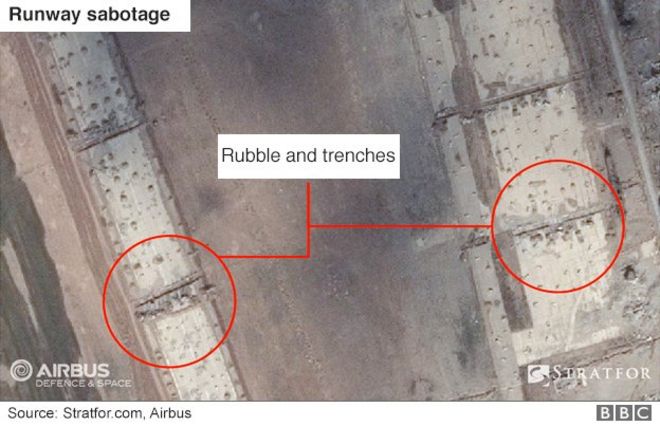
The damage to the runways has rendered the airport worthless as an asset for attacking forces, says Stratfor. Airports or runways are typically a primary objective for assaults on cities, since control over them can deny or enable logistical capabilities, having a considerable impact on the outcome of battles.
However, IS militants have ensured there is little left for approaching forces to gain by taking the site, Stratfor says.
IS employed a similar tactic at Qayyarah air base, 70km (43 miles) south of Mosul. However, the trenches dug there only partially covered the main runway, Stratfor says, and it was restored to service within months of the Iraqi forces recapturing the base in July.
By comparison, Mosul airport's destruction could be much more difficult to repair.
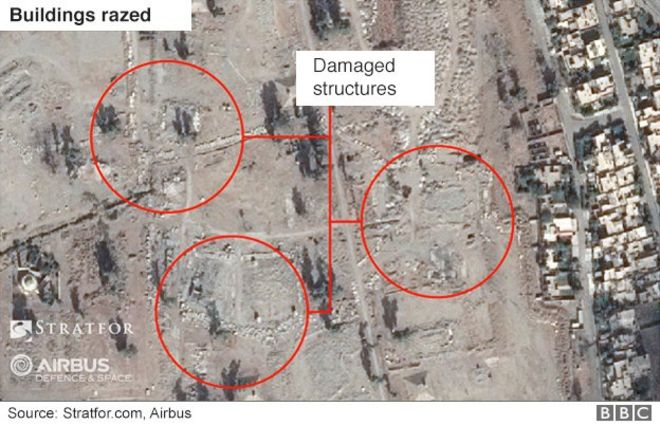
Mirroring the demolition at Qayyarah, IS fighters have also levelled almost every structure at Mosul airport.
Stratfor says that as well as preventing Iraqi forces and their allies from using the facilities, the tactic also serves to clear the line of sight for IS defensive positions on the northern edge of the airport.
Along with restoring the runways, Iraqi forces would need to rebuild hangars, warehouses and other infrastructure in order to use it as a logistical base.
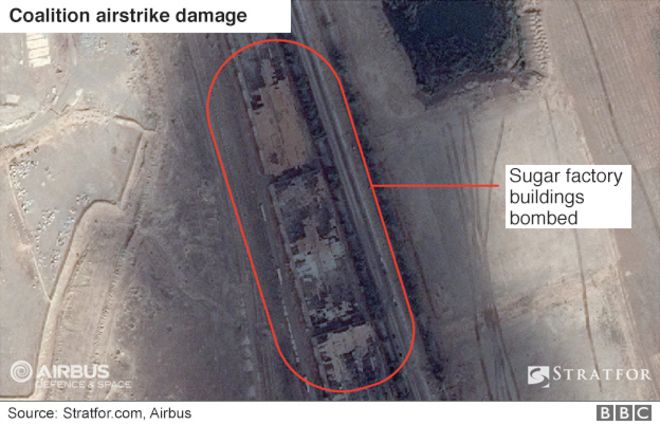
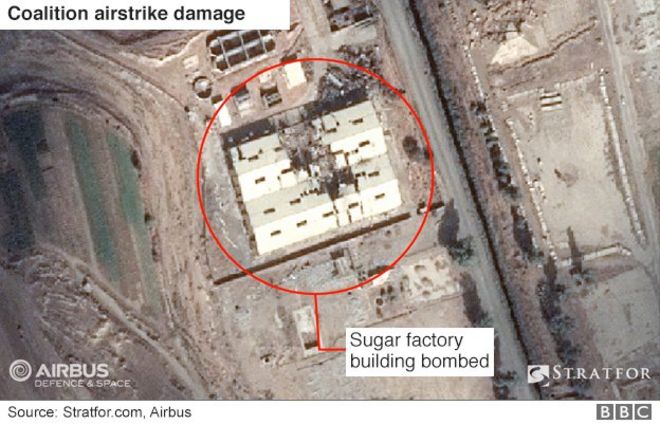
In contrast to the widespread destruction elsewhere in the area, the images show how the city's sugar factory remains relatively intact - testimony to its utility to IS.
After the jihadists captured Mosul in June 2014, they continued to operate the factory, says Stratfor, and more than a year later, executed the plant's manager when she refused to run it for them.
However, the images also show how coalition airstrikes, aimed at destroying key IS positions and assets, have caused some damage to the buildings.
Satellite imagery released last week, showed how IS had constructed multiple barricades across key routes into the northern Iraqi city.
http://www.bbc.co.uk/news/world-middle-east-37936530
Satellite images of Mosul have revealed how fighters from so-called Islamic State (IS) have destroyed much of the city's airport to render it unusable as Iraqi forces close in.
The imagery, released by US geopolitical intelligence company Stratfor and taken on 31 October, shows how almost all the buildings at the airport, on the southern outskirts of Mosul, have been razed.
Runways have also been damaged, with wide trenches carved into them and rubble placed along their lengths, Stratfor's analysis says. Taxiways and aprons - where aircraft park - have also been sabotaged.
About 50,000 Iraqi security forces, Kurdish Peshmerga fighters, Sunni Arab tribesmen and Shia militiamen, assisted by US-led coalition airstrikes, are currently involved in a military offensive to reclaim Mosul from IS militants.
Government forces have already retaken dozens of villages and towns surrounding the city and are currently consolidating gains made in Mosul's eastern outskirts.
The damage to the runways has rendered the airport worthless as an asset for attacking forces, says Stratfor. Airports or runways are typically a primary objective for assaults on cities, since control over them can deny or enable logistical capabilities, having a considerable impact on the outcome of battles.
However, IS militants have ensured there is little left for approaching forces to gain by taking the site, Stratfor says.
IS employed a similar tactic at Qayyarah air base, 70km (43 miles) south of Mosul. However, the trenches dug there only partially covered the main runway, Stratfor says, and it was restored to service within months of the Iraqi forces recapturing the base in July.
By comparison, Mosul airport's destruction could be much more difficult to repair.
Mirroring the demolition at Qayyarah, IS fighters have also levelled almost every structure at Mosul airport.
Stratfor says that as well as preventing Iraqi forces and their allies from using the facilities, the tactic also serves to clear the line of sight for IS defensive positions on the northern edge of the airport.
Along with restoring the runways, Iraqi forces would need to rebuild hangars, warehouses and other infrastructure in order to use it as a logistical base.
In contrast to the widespread destruction elsewhere in the area, the images show how the city's sugar factory remains relatively intact - testimony to its utility to IS.
After the jihadists captured Mosul in June 2014, they continued to operate the factory, says Stratfor, and more than a year later, executed the plant's manager when she refused to run it for them.
However, the images also show how coalition airstrikes, aimed at destroying key IS positions and assets, have caused some damage to the buildings.
Satellite imagery released last week, showed how IS had constructed multiple barricades across key routes into the northern Iraqi city.
http://www.bbc.co.uk/news/world-middle-east-37936530
My Name Is KURDISTAN And I Will Be FREE
-
Anthea - Shaswar
- Donator
- Posts: 31601
- Images: 1151
- Joined: Thu Oct 18, 2012 2:13 pm
- Location: Sitting in front of computer
- Highscores: 3
- Arcade winning challenges: 6
- Has thanked: 6019 times
- Been thanked: 743 times
- Nationality: Kurd by heart
Re: Updates on Ongoing Mosul Massacre
Author: Anthea » Fri Nov 11, 2016 8:23 pm
ISIS deploys child suicide bombers as Iraqi army advances
Islamic State fighters have killed scores of alleged spies or battlefield deserters in the past week and are dispatching boys as young as 12 to the frontlines with suicide belts as the group’s enemies advance on its last major strongholds.
Witnesses in Raqqa and Mosul – as well as the UN’s high commissioner for refugees – said Isis had also displaced tens of thousands of residents for use as human shields as it came under increasing military pressure.
The Iraqi army continues to make slow gains inside Mosul’s outer limits while, 260 miles (420km) to the west, a US-backed Kurdish force is edging towards Raqqa in Syria.
As each force advances, new details emerge of the savagery inflicted in the two cities. Nearly 48,000 refugees have fled Mosul, and many have described how the city’s Islamist occupiers are becoming ever more brutal.
Anyone suspected of collaboration with the encroaching Iraqi military has been killed, often in public squares. Several residents told the Guardian that in the past week, relatives and neighbours had been killed by Isis for reasons as trivial as carrying a mobile phone sim card.
According to the UN high commissioner for human rights. Zeid Ra’ad Al Hussein, Isis killed 40 alleged spies in Mosul on Tuesday and 20 more the following day.
On Monday, an underground prison was found in the Shura district, containing 961 men and boys who had been forced into cages as small as 1 metre by 0.5 metre. Many were emaciated and had been tortured.
Zeid said the unchecked brutality highlighted an urgent need for justice, truth and reconciliation. Without that, he said, revenge attacks and collective punishment would undermine efforts to reassemble the shattered communities of northern Iraq.
One man, Abu Lutfi, who arrived in a Kurdish-controlled area on Thursday, said he and his family had been among 500 people forced by Isis out of their homes and told to move to the west of Mosul. Lutfi said he suspected the terror group intended to use them as human shields against Shia militias. Instead, they made a perilous journey through Isis ranks and across lands conquered by Iraq’s national army.
“I swear they were getting even worse with the people,” he said. “At the beginning, they had asked sheikhs to swear allegiance to them, and many did. Now even those sheikhs are vulnerable. They are really paranoid about spies or collaborators.”
The wrath of the terror group has not spared its own members. Zeid said seven of its fighters were beheaded earlier this month for fleeing the battlefield, and Isis leaders had used loudspeakers to warn that the same fate would befall anyone else who tried to leave.
The high commissioner said Isis had moved sulphur from a giant pit near the town of Qayyarah that it ignited two weeks ago, to Shura, where a child reportedly died after inhaling sulphuric gas. Large quantities of sulphur had been stockpiled for use against advancing forces.
In Raqqa, Isis has been on a similar footing, stockpiling weapons, fortifying neighbourhoods and deploying child fighters, who have been indoctrinated through months of training, to areas where they suspect advancing Kurdish forces will attack the city.
A senior member of the organisation, with whom the Guardian has remained in contact over several years, said child fighters would be used in large numbers in the first and second lines of Raqqa’s defences.
“Many of these boys are sons of fighters who have been killed,” he said. “They have been programmed like robots. They fear nothing and are beyond being rescued.
“All the leaders know what is going on in Mosul. They are watching the news very closely and have been encouraged by the fact that the Iraqi security forces can’t go any further. They know how to fight them in the city, and they are confident that they can pin them down for a long time.
“In Raqqa it is different. It is much smaller, and harder to defend. There are not as many people to hide among. They know that Raqqa will be the last battle. But for now, they are busy preparing, while watching their televisions.”
Routes between Mosul and Raqqa remain open, despite the presence of large numbers of Shia militias west of Mosul, who have been tasked with blocking the escape of Isis members. For now, the extremists can move freely to Tel Afar, north-west of Mosul, which remains under Isis control. The towns of Billij and Baa’j, west of Tel Afar, remain firmly under the control of the group, as does the border town of Boukamel and the road inside Syria to Raqqa.
The ISIS leader Abu Bakr al-Baghdadi is widely believed to have been in Tel Afar and Baa’j in recent weeks, where he enjoys the protection of up to four tribes.
“He moves in a small area and has done for a long time,” the Isis source said. “I’m not sure that he is playing a direct role in the battle.”
After expecting Mosul to fall within weeks of the campaign to free it, which began on 17 November, Iraqi and Kurdish officials are now privately talking about the war lasting up to three months. Iraqi officers had prepared for stiff resistance, but have been surprised by the military strength of the group and its commitment to fighting.
At the same time, command and control among Iraqi forces has slipped at crucial times, raising concerns that large-scale operations of the type needed to push further into the city are several weeks away from being launched.
The battle for Raqqa is almost certainly even further away, sources have told the Guardian. Turkish officials say they have been assured by Washington that the current US proxy Kurdish force will “isolate but not enter Raqqa”, and that no force will be told to take the city before the January inauguration of President-elect Donald Trump.
https://www.theguardian.com/world/2016/ ... my-advance
Islamic State fighters have killed scores of alleged spies or battlefield deserters in the past week and are dispatching boys as young as 12 to the frontlines with suicide belts as the group’s enemies advance on its last major strongholds.
Witnesses in Raqqa and Mosul – as well as the UN’s high commissioner for refugees – said Isis had also displaced tens of thousands of residents for use as human shields as it came under increasing military pressure.
The Iraqi army continues to make slow gains inside Mosul’s outer limits while, 260 miles (420km) to the west, a US-backed Kurdish force is edging towards Raqqa in Syria.
As each force advances, new details emerge of the savagery inflicted in the two cities. Nearly 48,000 refugees have fled Mosul, and many have described how the city’s Islamist occupiers are becoming ever more brutal.
Anyone suspected of collaboration with the encroaching Iraqi military has been killed, often in public squares. Several residents told the Guardian that in the past week, relatives and neighbours had been killed by Isis for reasons as trivial as carrying a mobile phone sim card.
According to the UN high commissioner for human rights. Zeid Ra’ad Al Hussein, Isis killed 40 alleged spies in Mosul on Tuesday and 20 more the following day.
On Monday, an underground prison was found in the Shura district, containing 961 men and boys who had been forced into cages as small as 1 metre by 0.5 metre. Many were emaciated and had been tortured.
Zeid said the unchecked brutality highlighted an urgent need for justice, truth and reconciliation. Without that, he said, revenge attacks and collective punishment would undermine efforts to reassemble the shattered communities of northern Iraq.
One man, Abu Lutfi, who arrived in a Kurdish-controlled area on Thursday, said he and his family had been among 500 people forced by Isis out of their homes and told to move to the west of Mosul. Lutfi said he suspected the terror group intended to use them as human shields against Shia militias. Instead, they made a perilous journey through Isis ranks and across lands conquered by Iraq’s national army.
“I swear they were getting even worse with the people,” he said. “At the beginning, they had asked sheikhs to swear allegiance to them, and many did. Now even those sheikhs are vulnerable. They are really paranoid about spies or collaborators.”
The wrath of the terror group has not spared its own members. Zeid said seven of its fighters were beheaded earlier this month for fleeing the battlefield, and Isis leaders had used loudspeakers to warn that the same fate would befall anyone else who tried to leave.
The high commissioner said Isis had moved sulphur from a giant pit near the town of Qayyarah that it ignited two weeks ago, to Shura, where a child reportedly died after inhaling sulphuric gas. Large quantities of sulphur had been stockpiled for use against advancing forces.
In Raqqa, Isis has been on a similar footing, stockpiling weapons, fortifying neighbourhoods and deploying child fighters, who have been indoctrinated through months of training, to areas where they suspect advancing Kurdish forces will attack the city.
A senior member of the organisation, with whom the Guardian has remained in contact over several years, said child fighters would be used in large numbers in the first and second lines of Raqqa’s defences.
“Many of these boys are sons of fighters who have been killed,” he said. “They have been programmed like robots. They fear nothing and are beyond being rescued.
“All the leaders know what is going on in Mosul. They are watching the news very closely and have been encouraged by the fact that the Iraqi security forces can’t go any further. They know how to fight them in the city, and they are confident that they can pin them down for a long time.
“In Raqqa it is different. It is much smaller, and harder to defend. There are not as many people to hide among. They know that Raqqa will be the last battle. But for now, they are busy preparing, while watching their televisions.”
Routes between Mosul and Raqqa remain open, despite the presence of large numbers of Shia militias west of Mosul, who have been tasked with blocking the escape of Isis members. For now, the extremists can move freely to Tel Afar, north-west of Mosul, which remains under Isis control. The towns of Billij and Baa’j, west of Tel Afar, remain firmly under the control of the group, as does the border town of Boukamel and the road inside Syria to Raqqa.
The ISIS leader Abu Bakr al-Baghdadi is widely believed to have been in Tel Afar and Baa’j in recent weeks, where he enjoys the protection of up to four tribes.
“He moves in a small area and has done for a long time,” the Isis source said. “I’m not sure that he is playing a direct role in the battle.”
After expecting Mosul to fall within weeks of the campaign to free it, which began on 17 November, Iraqi and Kurdish officials are now privately talking about the war lasting up to three months. Iraqi officers had prepared for stiff resistance, but have been surprised by the military strength of the group and its commitment to fighting.
At the same time, command and control among Iraqi forces has slipped at crucial times, raising concerns that large-scale operations of the type needed to push further into the city are several weeks away from being launched.
The battle for Raqqa is almost certainly even further away, sources have told the Guardian. Turkish officials say they have been assured by Washington that the current US proxy Kurdish force will “isolate but not enter Raqqa”, and that no force will be told to take the city before the January inauguration of President-elect Donald Trump.
https://www.theguardian.com/world/2016/ ... my-advance
My Name Is KURDISTAN And I Will Be FREE
-
Anthea - Shaswar
- Donator
- Posts: 31601
- Images: 1151
- Joined: Thu Oct 18, 2012 2:13 pm
- Location: Sitting in front of computer
- Highscores: 3
- Arcade winning challenges: 6
- Has thanked: 6019 times
- Been thanked: 743 times
- Nationality: Kurd by heart
Re: Updates on Ongoing Mosul Massacre
Author: Anthea » Mon Nov 14, 2016 2:16 am
Iraqi troops are getting bogged down in Mosul – Could it spark the first crisis for President Trump?
Kurdish leaders are warning that what could have taken weeks is likely to drag on for months - posing problems for the US-led coalition and especially its incoming Commander-in-Chief
The Iraqi armed forces are becoming bogged down in the battle for Mosul. Its elite special forces and an armoured division are fighting to hold districts in the eastern outskirts of the city against counter-attacks by Isis fighters using networks of tunnels to move about unseen.
“In one day we lost 37 dead and 70 wounded,” said a former senior Iraqi official, adding that the Iraqi forces had been caught by surprise by the extent of the tunnel system built by Isis, said to be 45 miles long.
The Iraqi Counter-Terrorism Service (CTS) and the Ninth Armoured Division have been trying for two weeks to fight their way into that part of Mosul city, east of the Tigris River.
Isis is sending waves of suicide bombers either as individuals who blow themselves up or in vehicles packed with explosives, snipers and mortar teams, to restart the fighting in a dozen districts that the Iraqi Army had said were already captured.
"At first I was optimistic that we might capture Mosul in two or three weeks, but I now believe it will take months,” said Khasro Goran, a senior Kurdish leader familiar with conditions in Mosul, in an exclusive interview with The Independent.
He said he had changed his mind about the likely length of the siege when he witnessed the ferocity of the fighting in the outer defences of Mosul. He added that “if they [Isis] continue fighting like this then a lot of Mosul will be destroyed. I hope it will not be like Aleppo.
A prolonged siege of Mosul with heavy civilian casualties and the possibility of Turkish military intervention is likely to be the first international crisis to be faced by the incoming administration of President-elect Donald Trump. The slow and heavily-contested advance of the Iraqi armed forces into the city means that the attack will still be going on when he is inaugurated in Washington on 20 January.
Mr Trump would have to decide if he is willing to sanction an escalation in US-led airstrikes to destroy Isis defences, though this would inevitably lead to heavy loss of life among the estimated 1.5 million civilians in Mosul.
A threatened military intervention by Turkey will also become more likely if the best Iraqi combat units suffer heavy losses and look for reinforcements from the Shia paramilitary Hashd al-Shaabi (Popular Mobilisation) forces and the Kurdish Peshmerga.
Under an American-brokered agreement, these are being kept out of the city of Mosul itself to avoid sectarian and ethnic tensions between them and its Sunni Arab population.
Turkey has sent tanks to the Turkish-Iraqi border and said it may invade if the Hashd or Peshmerga fight inside Mosul.
The problem for the Iraqi armed forces is that they have previously relied heavily on US-led airstrikes to destroy Isis fighters in fixed positions. There have been 10,300 such airstrikes in Iraq since 2014.
In the battle for Ramadi in 2015 some 70 per cent of the city was destroyed, but almost all of the 350,000 population had fled and Isis did not fight to the last man. The same was true of the outer ring of towns around Mosul like Bartella and Qaraqosh a dozen more miles from the city, which were empty of their largely Christian inhabitants, making it easier to target and destroy from the air buildings held by ISIS.
The same tactics cannot be used in Mosul because its people are still there and the city is very big. The Baghdad government offensive that began on 17 October went well until it reached Mosul’s outskirts two weeks ago.
Since then the fighting has swung backwards and forwards with districts being captured or recaptured three or four times.
In al-Qadisiyah al-Thaniya district, which the CTS had entered on Friday, the elite soldiers later retreated and Isis fighters returned. A local resident told a news agency that “they came back to us again, and this is what we feared. At night there were fierce clashes and we heard powerful explosions.”
In Intisar, another embattled east Mosul district, the Iraqi army’s Ninth Armoured Division has found that its tanks are vulnerable in street fighting for which its soldiers have neither experience nor training. Last Tuesday it lost two T-72 tanks.
There were some signs of Isis disarray at the start of the siege. Hoshyar Zebari, the former Iraqi Finance and Foreign Minister, says that by far “the biggest surprise for Isis was some months back when the Iraqi government and the leaders of the Kurdistan Regional Government (KRG) agreed on a joint offensive against Isis in Mosul.” Isis did not expect this – Baghdad and the KRG had previously been barely on speaking terms because of economic and territorial disputes.
When Iraqi forces first attacked east Mosul, there were reports of wavering morale among some Isis fighters, but the Isis leadership has mercilessly enforced its control.
The UN says that it has executed some 70 civilians in Mosul accused of collaboration with Iraqi forces over the last week. Last Tuesday alone 40 people were dressed in orange jumpsuits and shot for “treason and collaboration” before being hanged from electricity poles.
Another 20 civilians have been shot for using mobile phones to leak information to the Iraqi army and their bodies were hanged at traffic lights.
The real level of support for Isis in Mosul is unclear. The 54,000 people who have fled the city and sought refuge behind Peshmerga or Iraqi army lands all express their hatred of movement and deplore its atrocities.
But local Christians and Kurds view the displaced civilians from Isis with suspicion as possible covert Isis supporters. “I see that Isis are getting their families to safety,” said one Christian driving past a camp of white tents occupied by Internally Displaced People (IDPs) at Khazar, east of Mosul.
Mr Goran is an expert on the internal politics of Mosul where he was deputy governor between 2003 and 2009, and leader of the Kurdistan Democratic Party (KDP) in the city until 2011. Speaking of the political sympathies of its people, he said that “a third of the population supports Isis, much of the rest is passive and only a small percentage actively resisted them.”
He believes that reports of extensive anti-Isis armed resistance inside the city was largely propaganda designed for the media. He pointed out that there might be a lot of foreign fighters in Mosul, but “the majority of fighters are Iraqis”.
http://www.independent.co.uk/news/world ... 15266.html
Kurdish leaders are warning that what could have taken weeks is likely to drag on for months - posing problems for the US-led coalition and especially its incoming Commander-in-Chief
The Iraqi armed forces are becoming bogged down in the battle for Mosul. Its elite special forces and an armoured division are fighting to hold districts in the eastern outskirts of the city against counter-attacks by Isis fighters using networks of tunnels to move about unseen.
“In one day we lost 37 dead and 70 wounded,” said a former senior Iraqi official, adding that the Iraqi forces had been caught by surprise by the extent of the tunnel system built by Isis, said to be 45 miles long.
The Iraqi Counter-Terrorism Service (CTS) and the Ninth Armoured Division have been trying for two weeks to fight their way into that part of Mosul city, east of the Tigris River.
Isis is sending waves of suicide bombers either as individuals who blow themselves up or in vehicles packed with explosives, snipers and mortar teams, to restart the fighting in a dozen districts that the Iraqi Army had said were already captured.
"At first I was optimistic that we might capture Mosul in two or three weeks, but I now believe it will take months,” said Khasro Goran, a senior Kurdish leader familiar with conditions in Mosul, in an exclusive interview with The Independent.
He said he had changed his mind about the likely length of the siege when he witnessed the ferocity of the fighting in the outer defences of Mosul. He added that “if they [Isis] continue fighting like this then a lot of Mosul will be destroyed. I hope it will not be like Aleppo.
A prolonged siege of Mosul with heavy civilian casualties and the possibility of Turkish military intervention is likely to be the first international crisis to be faced by the incoming administration of President-elect Donald Trump. The slow and heavily-contested advance of the Iraqi armed forces into the city means that the attack will still be going on when he is inaugurated in Washington on 20 January.
Mr Trump would have to decide if he is willing to sanction an escalation in US-led airstrikes to destroy Isis defences, though this would inevitably lead to heavy loss of life among the estimated 1.5 million civilians in Mosul.
A threatened military intervention by Turkey will also become more likely if the best Iraqi combat units suffer heavy losses and look for reinforcements from the Shia paramilitary Hashd al-Shaabi (Popular Mobilisation) forces and the Kurdish Peshmerga.
Under an American-brokered agreement, these are being kept out of the city of Mosul itself to avoid sectarian and ethnic tensions between them and its Sunni Arab population.
Turkey has sent tanks to the Turkish-Iraqi border and said it may invade if the Hashd or Peshmerga fight inside Mosul.
The problem for the Iraqi armed forces is that they have previously relied heavily on US-led airstrikes to destroy Isis fighters in fixed positions. There have been 10,300 such airstrikes in Iraq since 2014.
In the battle for Ramadi in 2015 some 70 per cent of the city was destroyed, but almost all of the 350,000 population had fled and Isis did not fight to the last man. The same was true of the outer ring of towns around Mosul like Bartella and Qaraqosh a dozen more miles from the city, which were empty of their largely Christian inhabitants, making it easier to target and destroy from the air buildings held by ISIS.
The same tactics cannot be used in Mosul because its people are still there and the city is very big. The Baghdad government offensive that began on 17 October went well until it reached Mosul’s outskirts two weeks ago.
Since then the fighting has swung backwards and forwards with districts being captured or recaptured three or four times.
In al-Qadisiyah al-Thaniya district, which the CTS had entered on Friday, the elite soldiers later retreated and Isis fighters returned. A local resident told a news agency that “they came back to us again, and this is what we feared. At night there were fierce clashes and we heard powerful explosions.”
In Intisar, another embattled east Mosul district, the Iraqi army’s Ninth Armoured Division has found that its tanks are vulnerable in street fighting for which its soldiers have neither experience nor training. Last Tuesday it lost two T-72 tanks.
There were some signs of Isis disarray at the start of the siege. Hoshyar Zebari, the former Iraqi Finance and Foreign Minister, says that by far “the biggest surprise for Isis was some months back when the Iraqi government and the leaders of the Kurdistan Regional Government (KRG) agreed on a joint offensive against Isis in Mosul.” Isis did not expect this – Baghdad and the KRG had previously been barely on speaking terms because of economic and territorial disputes.
When Iraqi forces first attacked east Mosul, there were reports of wavering morale among some Isis fighters, but the Isis leadership has mercilessly enforced its control.
The UN says that it has executed some 70 civilians in Mosul accused of collaboration with Iraqi forces over the last week. Last Tuesday alone 40 people were dressed in orange jumpsuits and shot for “treason and collaboration” before being hanged from electricity poles.
Another 20 civilians have been shot for using mobile phones to leak information to the Iraqi army and their bodies were hanged at traffic lights.
The real level of support for Isis in Mosul is unclear. The 54,000 people who have fled the city and sought refuge behind Peshmerga or Iraqi army lands all express their hatred of movement and deplore its atrocities.
But local Christians and Kurds view the displaced civilians from Isis with suspicion as possible covert Isis supporters. “I see that Isis are getting their families to safety,” said one Christian driving past a camp of white tents occupied by Internally Displaced People (IDPs) at Khazar, east of Mosul.
Mr Goran is an expert on the internal politics of Mosul where he was deputy governor between 2003 and 2009, and leader of the Kurdistan Democratic Party (KDP) in the city until 2011. Speaking of the political sympathies of its people, he said that “a third of the population supports Isis, much of the rest is passive and only a small percentage actively resisted them.”
He believes that reports of extensive anti-Isis armed resistance inside the city was largely propaganda designed for the media. He pointed out that there might be a lot of foreign fighters in Mosul, but “the majority of fighters are Iraqis”.
http://www.independent.co.uk/news/world ... 15266.html
My Name Is KURDISTAN And I Will Be FREE
-
Anthea - Shaswar
- Donator
- Posts: 31601
- Images: 1151
- Joined: Thu Oct 18, 2012 2:13 pm
- Location: Sitting in front of computer
- Highscores: 3
- Arcade winning challenges: 6
- Has thanked: 6019 times
- Been thanked: 743 times
- Nationality: Kurd by heart
Who is online
Registered users: Bing [Bot], Google [Bot], Majestic-12 [Bot]