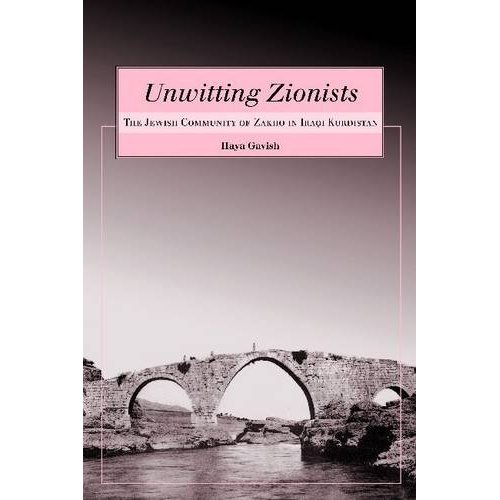
Unwitting Zionists examines the Jewish community in the northern Kurdistan town of Zakho from the end of the Ottoman period until the disappearance of the community through alihyah by 1951. Because of its remote location, Zakho was far removed of the influence of the Jewish religious leadership in Iraq and preserved many of its religious traditions independently, becoming known as “Jerusalem of Kurdistan”, the most important Jewish community in the region. Author Haya Gavish argues that when the community was exposed to Zionism, it began to open up to external influences and activity. Originally published in Hebrew, Unwitting Zionists uses personnal memoirs, historical records, and interviews to investigate the duality between Jewish traditions and Zionism among Zakho’s Jews.
Gavish consults a variety of sources to examine the changes undergone by the Jewish community as a result of its religious affiliation with Eretz-Israel, its exposure to Zionist efforts, and its eventual immigration to Israël. Because relatively little written documentation about Zakho exists, Gavish relies heavily on folkloristic sources like personnal recollections ans traditionnal stories, including extensive material from her own fieldwork with an economically and demographically diverse group of men and women from Zakho. She analyzes this firsthand information within a historical framework to reconstruct a communal reality and lifestyle that was virtually unknown to anyone outside of the community. Gavish also addresses the relative merits of personnal memoirs, optimal interviewer-interviewees’ memories in her study. Biographical details of the interviewees are included for additionnal background. Folklore, oral history, anthropology, and Israeli studies scholars, as well as anyone wanting to learn more about religion, community, and nationality in the Middle-East will appreciate Unwitting Zionists.
Haya Gavish is lecturer in Hebrew language and literature at the Hebrew Union College-Jewish Institute of Religion, Jerusalem.
Table des chapitres :
Preface
Abbreviations
1. Between Folklore and History
2. Zakho, an Island in the River.
3. Religious Attachment to Eretz-Israel.
4. Rabbinical Emmissaries : A Bridge to Eretz-Israel.
5. Aliyah in the Prestate Period : The Historical Context.
6. The British Mandate Period : Aliyah at All Costs.
7. Zionism in Zakho : Zionist Cell or Center for Illegal Immigration ?
8. Social Upheaval and National Emancipation.
Epilogue.
Interviewees : Biographies of Members of the Zakho Community.
Interviewees : Emmissaries to the Zionist Underground in Iraq.
Notes
Bibliography
Index.
Avant-propos :
Toward the end of 1948, the family of Abraham Zaqen hired Jewish raftsmen from Zakho to transport sawed trees down to the river and floated them to Mosul, where they were to be sold. A heavy snowstorm delayed them up for a few days in one of the villages, and only on the sabbath the sun finally break through the clouds. They dearly wanted to warm themselves, but due to the Sabbath refrained from lighting a fire. And so, they began dancing, in traditionnal Kurdish fashion : the lead dancer sang “tee, tee, tee”, waving a kerchief in his free hand, and all the others replied, “Israel”, referrinf to the Jews, the People of Israel. That was the tradition among Zakho Jews. Some Kurds also gathered round the enthusiastic dancers, but one of them – a policeman, a soldier, or a drunk – complained to the authorities, accusing the Jews of “Zionism”. The dancers were arrested, brought to Zakho and from there to Mosul, where four of the oldest among them were freed. The other eleven were taken to Baghdad for trial in a military court and sentenced to imprisonment. From that day on, the Jews of Zakho had their own “Prisonners of Zion” (Heb. assirei tziyyon, persons who were persecuted because of their Zionist activity or aspiration).
I heard many versions of this story from former Zakho Jews, four of whom were among those inprisoned. Although there was a consensus among all my interviewees about the event itself, for many years they disagreed regarding details and interpretation. Did the raftsmen dance innocently to warm themselves or were they expressing their joy at the establishment of the State of Israël ? Did the lead dancer wave a simple kerchief or was it intended the Israeli flag ? Was “tee, tee, tee, Israel” merely a traditionnal phrase, sung when dancing at weddings and other celebrations, referring to the People of Israël throughout its lengthy history ? This episode was a traumatic event for the Jews of Zakho. When their community came to an end in 1951, with the mass immigration to Israel, the prisonners remained behind, in jail. They were released only later and came to Israel with the last migrants from Iraq.
This episode is indicative of the duality between Jewish tradition and Zionism among the Jews of Zakho. Such duality in Jewish communities tje world over, including those in Islamic countries, has been the subject of much research. It is not my intention to define Zionism, but rather to delineate the Zionist consciousness of Jews in this community, as understood and put forward by those whom I interviewed. Though the community of Zakho, a town in northern Iraqi Kurdistan, was geographically remote and far removed from the influence of the Jewish religious leaderhsip in Iraq, it unswervingly preserved its traditionnal – that is, religious – character. It generally wrestled with its problems by itself and, as the most important community in the region, was sometimes known as the “Jerusalem of Kurdistan” (…).
 Ottoman Propaganda and Turkish Identity
 Taschenbuch: 245 Seiten